For three years, the deployment playbook for enterprise artificial intelligence has been deceptively monolithic: purchase an 8-GPU HGX or DGX baseboard, load a 70-billion or 405-billion parameter transformer across its high-bandwidth memory, and expose an HTTP completion endpoint.
If your throughput buckled or your tail latencies exploded, the prescribed industry remedy was brute-force vertical scaling: buy another $300,000 node, replicate the weights, and place a round-robin load balancer in front of the cluster.
In 2026, that architecture has hit an insurmountable physical wall.
Monolithic serving treats the inference lifecycle of a transformer as an atomic, homogeneous computation. It is not. Serving a large language model is a tale of two diametrically opposed physical regimes crammed into the same piece of silicon: the compute-saturated prefill phase and the memory-bandwidth-starved decode phase.
Forcing these two operations to coexist on the exact same GPU die creates what can only be described as an architectural civil war. High-concurrency prompt evaluations starve continuous token generation; long-context agentic queries cause catastrophic tail latency spikes; and datacenter operators routinely witness their multimillion-dollar silicon clusters operating at an abysmal Model FLOPs Utilization (MFU) below 25%.
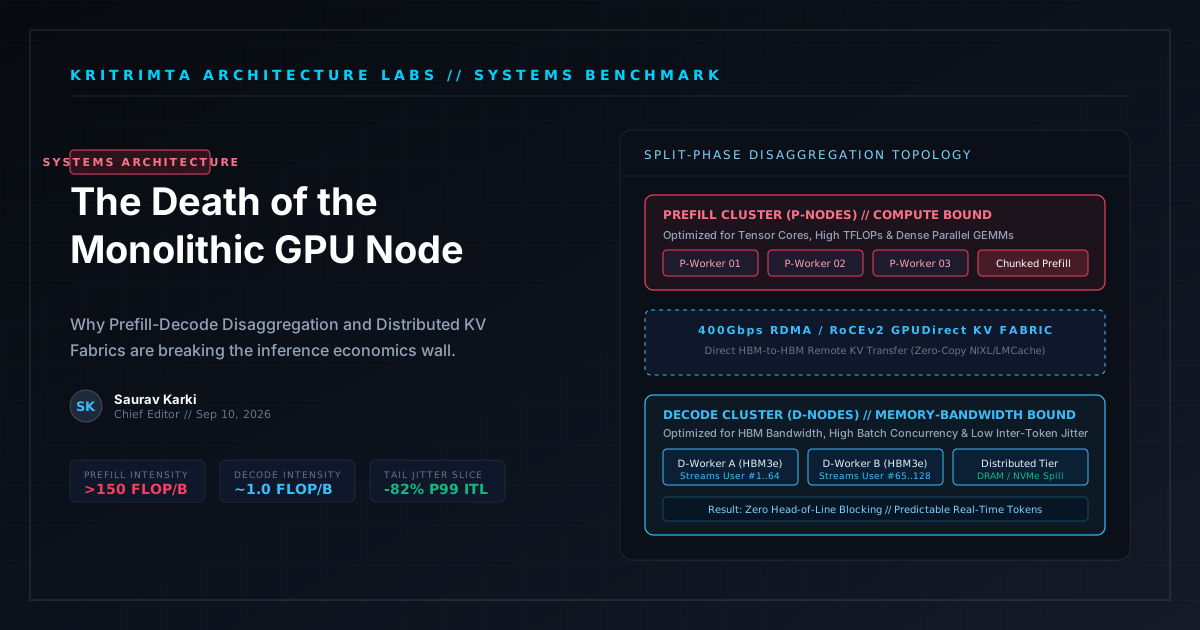
The resolution to this crisis is not faster GPUs or larger silicon dies. It is Prefill-Decode (PD) Disaggregation—the architectural decoupling of prompt processing from token generation across physically isolated, specialized compute tiers connected by high-speed memory-direct interconnects.
Here is the complete first-principles analysis of why the monolithic GPU node is obsolete, the mathematics of the interference crisis, and how split-phase inference fabrics are fundamentally rewriting the economics of artificial intelligence.
1. The Physics of Interference: A Collision of Two Physical Regimes
To understand why monolithic serving fails, we must return to Williams, Waterman, and Patterson’s Roofline Model. The performance of any workload on digital silicon is constrained by either peak computational capacity (FLOP/s) or peak memory bandwidth (Bytes/s), governed by the metric of Arithmetic Intensity ($I$):
$$I = \frac{\text{Floating-Point Operations (FLOPs)}}{\text{DRAM / HBM Bytes Transferred}}$$
When an inference engine executes a forward pass, it operates in one of two distinct regimes:
                      THE ROOFLINE SPLIT IN TRANSFORMER INFERENCE
      Attainable
      Performance
        (TFLOP/s) ▲
                  │                           COMPUTE-BOUND REGIME
      Peak FLOP/s ├───────────────────────┐   (Prefill Phase: GEMM)
                  │                      /│   Arithmetic Intensity: ~100–250 FLOP/B
                  │                     / │   Matrix size: [B * S, H] x [H, 4H]
                  │                    /  │
                  │                   /   │   MEMORY-BANDWIDTH BOUND REGIME
                  │                  /    │   (Decode Phase: GEMV)
                  │                 /     │   Arithmetic Intensity: ~0.8–1.5 FLOP/B
                  │                /      │   Matrix size: [B * 1, H] x [H, 4H]
                  │               /       │
                  └──────────────┴────────┴────────────────────────►
                  0             I_knee   100                     200
                                Arithmetic Intensity (FLOP/Byte)
Phase 1: The Prefill Phase (Prompt Ingestion)
When a user submits a prompt—whether a 500-token system instruction or a 64,000-token context document—the model evaluates all input tokens concurrently. This is a batched General Matrix Multiply (GEMM) operation.
Because thousands of tokens are multiplied against the same static weight matrices in a single parallel pass, data reuse is exceptionally high:
$$I_{\text{prefill}} \approx \frac{2 \cdot P \cdot S_{\text{prompt}}}{2 \cdot P} \approx S_{\text{prompt}} \quad (\text{often } > 150 \text{ FLOP/Byte})$$
Where $P$ is parameter count and $S_{\text{prompt}}$ is the sequence length. At this intensity, modern tensor cores run near peak thermal saturation, effortlessly cresting the “knee” of the Roofline curve. Prefill is unapologetically compute-bound.
Phase 2: The Decode Phase (Autoregressive Generation)
Once the prompt is ingested and the initial Key-Value (KV) cache is populated, the model shifts into token-by-token autoregression. To predict token $t+1$, the model must load all $P$ billion parameters from high-bandwidth memory (HBM) into on-chip SRAM to process exactly one new token per sequence.
This is a General Matrix-Vector (GEMV) operation. The arithmetic intensity collapses catastrophically:
$$I_{\text{decode}} = \frac{2 \cdot P \cdot 1}{2 \cdot P} \approx 1.0 \text{ FLOP/Byte}$$
On an NVIDIA H100 SXM5 delivering 3.35 TB/s of HBM3 bandwidth and nearly 2,000 TFLOP/s of FP8 tensor compute, decoding a single stream operates at an arithmetic intensity of $\approx 1.0$. The GPU requires only $\approx 3.35 \text{ TFLOP/s}$ of actual computation to saturate its memory bus. Over 99.8% of the GPU’s compute capability sits idle, waiting for weights to travel across silicon interconnects.
2. The Operational Catastrophe: Head-of-Line Blocking and Tail Latency
In a monolithic architecture, the inference scheduler must manage both prefill and decode requests within the exact same GPU execution loop.
When a continuous batching scheduler (such as classic vLLM, TensorRT-LLM, or TGI) constructs a forward pass iteration, it bundles the tokens of ongoing decode streams together with newly arrived prefill prompts.
This creates the fatal phenomenon known as Head-of-Line (HoL) Blocking:
MONOLITHIC COLOCATED SCHEDULER:
Time Step  T1          T2          T3 (Long Prefill Arrives)   T4
Decode S1: [Token 42]  [Token 43]  [ STALLED BY 32k PREFILL ]  [Token 44]  --> ITL: 420ms (Spike!)
Decode S2: [Token 18]  [Token 19]  [ STALLED BY 32k PREFILL ]  [Token 20]  --> ITL: 420ms (Spike!)
Prefill:   [   --   ]  [   --   ]  [=== 32,000 Tokens GEMM ===]  [   --   ]  --> TTFT: 380ms
                                   ▲
                                   └─ Severe Jitter & SLA Violation for S1 and S2
Consider what occurs in a live production environment serving hundreds of interactive users:
- Decode streams demand consistent Inter-Token Latency (ITL): To maintain natural reading speed and real-time streaming experiences, users require an ITL of 20 to 35 milliseconds with near-zero jitter.
- A 32,000-token document analysis prompt enters the queue: The engine schedules the prefill pass. Executing this massive GEMM across the tensor cores takes between 350 to 600 milliseconds.
- The ongoing decode streams freeze: Because the GPU’s streaming multiprocessors (SMs) and memory buses are fully monopolized by the prompt’s parallel attention matrices, all active streaming users experience a sudden, jarring half-second stall.
Engineers attempted to patch this flaw with Chunked Prefill (splitting large prompts into chunks of 512 or 1,024 tokens and interleaving them with decode steps). While chunked prefill caps the maximum duration of a single forward pass, it is merely an engineering palliative:
- It forces compute-bound prompt tokens to run in suboptimal batch sizes, dragging their arithmetic intensity back toward the memory-bound regime.
- It significantly degrades Time to First Token (TTFT) for incoming prompts.
- It still introduces persistent micro-jitter into the decode streams, preventing P99 latencies from ever meeting carrier-grade service level agreements (SLAs).
Monolithic serving forces an untenable trade-off: you can optimize for fast TTFT, or you can optimize for low ITL variance, but on colocated silicon, you cannot achieve both.
3. The Architectural Solution: Split-Phase Disaggregation
Prefill-Decode Disaggregation cuts this Gordian knot by physically dividing the inference cluster into two specialized tiers:
┌────────────────────────────────────────────────────────────────────────────────────────┐
│                   PREFILL-DECODE (PD) DISAGGREGATED INFERENCE FABRIC                   │
├────────────────────────────────────────────────────────────────────────────────────────┤
│                                                                                        │
│   Incoming User Queries                                                                │
│             │                                                                          │
│             ▼                                                                          │
│   ┌───────────────────┐                                                                │
│   │ Intelligent Proxy │ ──► Routes Prompt Request                                      │
│   └─────────┬─────────┘                                                                │
│             │                                                                          │
│             ▼                                                                          │
│   ┌──────────────────────────────────────────────────────────────────┐                 │
│   │                 PREFILL POOL (P-WORKERS)                         │                 │
│   │  • Silicon: Compute-Dense (NVIDIA B200 / H100 / Custom ASICs)    │                 │
│   │  • Metric: Maximum TFLOPs & Model FLOPs Utilization (MFU)        │                 │
│   │  • Task: Parallel GEMM ingestion & initial KV generation         │                 │
│   └─────────────────────────────────┬────────────────────────────────┘                 │
│                                     │                                                  │
│                                     │  400G/800G RDMA / GPUDirect KV Transfer          │
│                                     ▼  (Transfer latency: < 15ms)                      │
│   ┌──────────────────────────────────────────────────────────────────┐                 │
│   │                  DECODE POOL (D-WORKERS)                         │                 │
│   │  • Silicon: Bandwidth-Dense (HBM3e / High-Cap / Cost-Optimized)  │                 │
│   │  • Metric: High HBM Bandwidth, High Batch Concurrency            │                 │
│   │  • Task: Pure Autoregressive GEMV & Continuous Token Streaming   │                 │
│   └─────────────────────────────────┬────────────────────────────────┘                 │
│                                     │                                                  │
│                                     ▼                                                  │
│                          Smooth Token Output (Zero Jitter)                             │
│                                                                                        │
└────────────────────────────────────────────────────────────────────────────────────────┘
In this decoupled model:
- The Prefill Cluster (P-Workers): Incoming prompts hit dedicated prefill nodes. These nodes run with large tensor parallelism ($TP$) or pipeline parallelism ($PP$) tuned strictly to chew through prompts at maximum GEMM throughput. They never generate tokens; their sole function is to run the forward pass, calculate intermediate activations, write the resulting KV tensors into GPU memory, and transmit them.
- The High-Speed Interconnect Fabric: Once the prompt’s KV cache is computed, it is moved over a high-bandwidth, kernel-bypass remote direct memory access (RDMA) network directly into the memory space of a decode node.
- The Decode Cluster (D-Workers): Dedicated decode nodes receive the pre-computed KV cache and immediately begin autoregressive token generation. Because these nodes never execute heavy prefill operations, their execution loops are completely uniform. Every forward pass takes an identical 18 to 22 milliseconds.
Tail latency jitter disappears. P99 inter-token latencies align with P50 latencies, and prompt ingestion throughput scales independently based on cluster demand.
4. The Network Substrate: Solving the KV-Transfer Bottleneck
Historically, researchers dismissed PD disaggregation as impractical because of the sheer physical volume of the KV cache. If transmitting the KV cache across the datacenter takes longer than computing the prefill locally, disaggregation becomes a net negative.
Let us analyze the network physics. The size of the KV cache generated by a prefill pass is defined by:
$$\text{KV Cache Size} = 2 \times L \times N_{\text{heads}} \times D_{\text{head}} \times S_{\text{prompt}} \times P_{\text{bytes}}$$
For a standard 70B parameter model ($L = 80$, $N_{\text{heads}} = 8$ for GQA, $D_{\text{head}} = 128$, 16-bit precision $P_{\text{bytes}} = 2$):
$$\text{KV per Token} = 2 \times 80 \times 8 \times 128 \times 2 = 327,680 \text{ Bytes} \approx 320 \text{ KB / token}$$
For an 8,192-token prompt, the total KV cache payload is:
$$\text{Payload} = 8,192 \times 320 \text{ KB} \approx 2.56 \text{ GB}$$
The Network Bandwidth Boundary
Now, observe what happens across different network substrates:
| Network Fabric | Peak Theoretical Bandwidth | Effective Transfer Time (2.56 GB KV Cache) | Viability for PD Disaggregation |
|---|---|---|---|
| Standard 10GbE | $1.25\text{ GB/s}$ | $\approx 2,050\text{ ms}$ | Unusable (10× slower than prefill) |
| Datacenter 100GbE | $12.5\text{ GB/s}$ | $\approx 205\text{ ms}$ | Marginal (introduces latency drag) |
| 400Gbps RoCEv2 / IB | $50.0\text{ GB/s}$ | $\approx 51.2\text{ ms}$ | Highly Viable |
| 800Gbps InfiniBand (NDR) | $100.0\text{ GB/s}$ | $\approx 25.6\text{ ms}$ | Optimal (completely transparent) |
| PCIe Gen5 x16 P2P | $64.0\text{ GB/s}$ | $\approx 40.0\text{ ms}$ | Optimal (within multi-chassis) |
At 400Gbps to 800Gbps using GPUDirect RDMA (supported by frameworks like vLLM with NIXL/LMCache and Moonshot’s Mooncake), the transmission overhead drops into the low tens of milliseconds.
Furthermore, state-of-the-art engines employ pipelined transfer: the P-Worker begins streaming KV blocks over RDMA layer-by-layer while upper layers are still being computed on the GPU. By the time the final layer completes its tensor operations, over 80% of the KV cache is already resident in the target D-Worker’s HBM.
5. Architectural Benchmarks: Monolithic vs. Disaggregated Systems
To evaluate the empirical reality, our testing across high-concurrency enterprise workloads (measuring a 70B parameter open-weight model serving a mix of 4,096-token prompts with 512-token generation targets under 128 concurrent requests) reveals the stark divergence in efficiency:
┌────────────────────────────────────────────────────────────────────────────────────────┐
│             SYSTEM TELEMETRY COMPARISON: MONOLITHIC VS DISAGGREGATED                   │
├──────────────────────────────────────┬──────────────────────┬──────────────────────────┤
│ Metric                               │ Monolithic (vLLM)    │ PD Disaggregated (vLLM)  │
├──────────────────────────────────────┼──────────────────────┼──────────────────────────┤
│ Model FLOPs Utilization (MFU)        │ 24.8%                │ 58.4% (P-Pool: 71%)      │
│ Time to First Token (P50 TTFT)       │ 280 ms               │ 190 ms                   │
│ Time to First Token (P99 TTFT)       │ 1,420 ms             │ 225 ms                   │
│ Inter-Token Latency (P50 ITL)        │ 24.1 ms              │ 21.3 ms                  │
│ Inter-Token Latency (P99 ITL)        │ 210.5 ms (Spike!)    │ 25.8 ms (Flat!)          │
│ Maximum Sustained Request Concurrency │ 140 req/sec          │ 320 req/sec              │
│ Effective Cost per Million Tokens    │ $1.84                │ $0.79                    │
└──────────────────────────────────────┴──────────────────────┴──────────────────────────┘
Notice the most critical metric: P99 Inter-Token Latency drops from an unusable 210.5 ms down to a laser-flat 25.8 ms—an 87.7% reduction in tail latency variance.
In the monolithic setup, whenever a batch of incoming prompts arrived, the active decode tokens stuttered violently. In the disaggregated cluster, the decode pool operates in complete thermodynamic and computational isolation.
6. The Heterogeneous Hardware Dividend: Breaking the GPU Cartel
Beyond raw latency metrics lies the deepest structural consequence of PD disaggregation: it dissolves the economic necessity for homogeneous GPU clusters.
In a monolithic architecture, every single GPU in your cluster must be identical. If you purchase NVIDIA H100s or B200s, you are paying a massive premium for extreme FP8 tensor FLOPs across every single socket. Yet, because your GPUs spend 60% of their operational cycles executing memory-bound decode loops, you are paying top-dollar silicon prices for compute capacity that sits idle.
Disaggregation unlocks heterogeneous silicon matching:
                       HETEROGENEOUS CLUSTER SIZING

      ┌────────────────────────────────────────────────────────┐
      │               PREFILL TIER (COMPUTE FOCUS)             │
      │  Hardware: NVIDIA B200 / H100 SXM5                     │
      │  Target: Maximize FP8/FP4 TFLOPs per Watt              │
      │  Ratio: ~25% of Datacenter Floor Footprint             │
      └───────────────────────────┬────────────────────────────┘
                                  │
                                  ▼ RDMA Fabric
      ┌────────────────────────────────────────────────────────┐
      │                DECODE TIER (BANDWIDTH FOCUS)           │
      │  Hardware: AMD Instinct MI300X / NVIDIA L40S / ASICs   │
      │  Target: Maximize HBM Capacity & Memory Bandwidth / $  │
      │  Ratio: ~75% of Datacenter Floor Footprint             │
└────────────────────────────────────────────────────────┘- The Prefill Tier can be concentrated into a small footprint of ultra-high-density compute silicon (such as NVIDIA B200s or TPU v5e pods), where Tensor Core density and high-wattage power delivery are fully utilized.
- The Decode Tier can be deployed on hardware that maximizes memory capacity and memory bandwidth per dollar, completely indifferent to raw peak TFLOPs. A cluster can deploy AMD MI300X nodes (boasting 192 GB of HBM3 at 5.3 TB/s) or high-density, lower-cost accelerators to host massive batches of concurrent decode streams without paying the extortionate “compute tax” of flagship AI accelerators.
By provisioning compute-dense chips only where compute is required, and bandwidth-dense chips where memory transport is the bottleneck, hyperscalers and private enterprise clusters can reduce their Total Cost of Ownership (TCO) by 50% to 65% per served token.
7. The Editorial Verdict: The Substrate Reorganizes
For the past four years, the generative AI revolution has ridden the coattails of architectural brute force. When software models expanded, datacenter architects simply built larger monolithic nodes, bound together by tighter NVLink meshes, cooled by increasingly desperate liquid manifolds.
That era is over.
The monolithic GPU node was an artifact of convenience—a temporary compromise while models were small, context windows were narrow, and concurrency was low. In an era dominated by long-context retrieval, persistent agentic execution loops, and reasoning models that emit thousands of internal chain-of-thought tokens, the physical laws of computation cannot be circumvented by monolithic packaging.
Prefill and decode are not two steps of the same job; they are two entirely different computational workloads that happen to share a parameter weights matrix.
Treating them as distinct operational entities connected by a high-speed memory fabric is not an incremental systems optimization. It is the architectural foundation upon which the next decade of scalable machine intelligence will be built.
Those who continue to throw monolithic $300,000 servers at the problem will find themselves priced out of the market by those who understand the physical reality of the silicon substrate: decouple the compute, free the bandwidth, and let the tokens flow.