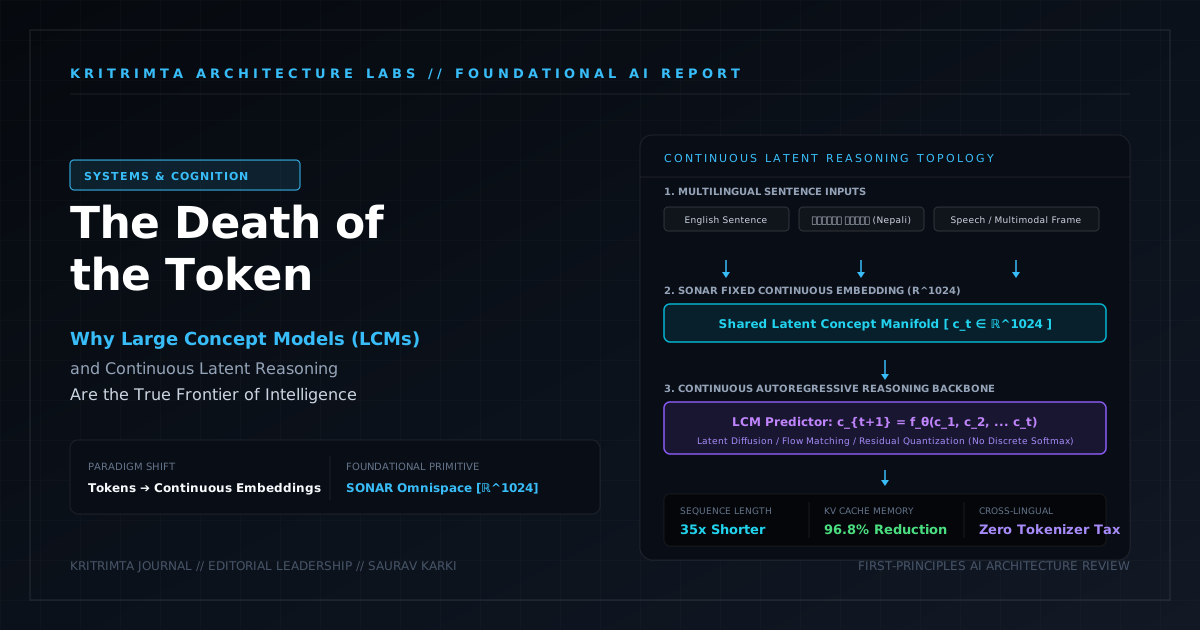
For nearly a decade, the foundational dogma of generative artificial intelligence has rested on an unchallenged, ubiquitous primitive: the discrete subword token.
From the early days of GPT-2 through the contemporary era of multi-trillion-parameter frontier clusters, our entire paradigm of machine intelligence has been modeled as a discrete Markovian sequence:
$$P(W) = \prod_{i=1}^{N} P(w_i \mid w_1, w_2, \dots, w_{i-1})$$
We slice human knowledge into arbitrary character fragments via Byte-Pair Encoding (BPE) or WordPiece, project them into discrete lookup dictionaries, and force massive transformer matrices to execute billions of floating-point operations simply to guess which subword fragment comes next.
This approach yielded spectacular empirical triumphs in surface fluency and syntactic mimicry. But as the frontier attempts to transition from fluent conversationalists to autonomous mathematical agents, software engineers, and scientific reasoning engines, the discrete token has transformed from our greatest accelerator into our most crippling structural bottleneck.
The dirty secret of modern frontier AI is that tokens are an unnatural, high-entropy tax on intelligence. Human beings do not think in tokens. When a mathematician sketches a proof, when an architect blueprints a structural cantilever, or when a novelist maps a narrative arc, they do not sequentially string syllables together in a greedy autoregressive loop. Human cognition operates on hierarchical conceptual topologies—continuous, language-agnostic semantic representations that are planned, manipulated, and stress-tested in abstract thought long before a single word is articulated.
The architectural revolution now breaching the frontier—spearheaded by Large Concept Models (LCMs) and continuous latent reasoning—shatters this token orthodoxy. By discarding the discrete vocabulary bottleneck in favor of continuous sentence-level semantic representations (such as Meta FAIR’s SONAR embedding manifold), LCMs alter the mathematical, cognitive, and physical economics of neural computation.
Here is the complete, first-principles architectural breakdown of why the token must die, how Large Concept Models operate under the hood, and what continuous latent reasoning means for the future of artificial intelligence.
1. The Orthodox Fallacy: The Next-Token Autoregressive Trap
To understand why Large Concept Models represent an existential paradigm shift, we must first isolate the physical and information-theoretic failures of the discrete next-token prediction regime.
Discrete Token Autoregression (The Greedy Syllable Trap):
[ "The" ] ──► [ " capital" ] ──► [ " of" ] ──► [ " Nepal" ] ──► [ " is" ] ──► [ " Kath" ] ──► [ "mandu" ]
                                                                                ▲
                                       (Zero global planning; 1 forward pass per fragment)
A. The Compounding Error Rate of Discrete Sampling
In standard autoregressive language modeling, generation is greedy and myopic. At each step $t$, the model projects its hidden state through an unembedding projection matrix $W_U \in \mathbb{R}^{d \times |V|}$, evaluates a categorical softmax over a vocabulary of 128,000 to 256,000 discrete indices, and samples a single token.
Because the state space is discrete and non-differentiable across time steps, any sub-optimal token choice introduces an irreversible deviation in the trajectory:
$$\epsilon_{\text{total}} \sim \mathcal{O}\left(\sum_{t=1}^{L} \epsilon_t \cdot \gamma^{L-t}\right)$$
If an autoregressive model makes an exploratory or slightly erroneous commitment at token $t=40$, it cannot softly back-propagate or fluidly adjust its trajectory at inference time; it has altered its conditioning context for all subsequent tokens $t > 40$. The model becomes trapped by its own syntax, frequently hallucinates justifications to preserve surface consistency with its early mistake, and collapses into logical incoherence.
B. The Structural Absence of Hierarchical Planning
True reasoning requires what cognitive science classifies as hierarchical abstraction: formulating a macro-level strategy (the concept) before executing micro-level tactical actions (the words).
When a standard LLM is asked to write an intricate multi-threaded sorting algorithm, it is forced to solve the global architectural design of the software concurrently with deciding whether to insert an indentation space, a closing parenthesis, or an alphanumeric variable name. This forces the transformer’s highest-level attention layers to waste capacity resolving low-level syntactic trivia. It is the computational equivalent of requiring an urban planner to lay down individual grains of asphalt while designing a metropolitan transit network.
C. The Artificial Language and Modality Tax
Discrete subword tokenization is a historical accident of natural language processing, optimized for English text compression rather than cognitive invariance.
Consider the simple proposition: “The capital of Nepal is Kathmandu.”
- In English, this statement decomposes into approximately $7$ tokens.
- In Nepali (“नेपालको राजधानी काठमाडौँ हो”), the exact same semantic truth is fragmented by standard tokenizers into $18$ to $24$ byte-level sub-tokens.
Because autoregressive inference cost scales with sequence length, non-English speakers and low-resource linguistic communities pay a massive “tokenizer tax”: $3\times$ higher inference latency, $3\times$ higher memory bandwidth consumption, and lower effective reasoning depth. Discrete tokens fragment concepts along arbitrary phonetic and orthographic boundaries that have zero relevance to the underlying truth of the proposition.
2. The Anatomy of Large Concept Models (LCMs)
Large Concept Models abandon discrete token generation entirely. Instead of predicting the next subword token from a finite vocabulary dictionary, an LCM predicts the next continuous semantic concept vector within an unconstrained, high-dimensional latent space.
┌────────────────────────────────────────────────────────────────────────┐
│               LARGE CONCEPT MODEL (LCM) TRI-TIER TOPOLOGY              │
├────────────────────────────────────────────────────────────────────────┤
│                                                                        │
│   Multilingual / Multimodal Inputs (Text, Audio, Code)                 │
│   ["The capital of Nepal is Kathmandu."]  ["नेपालको राजधानी काठमाडौँ हो"] │
│                            │                         │                 │
│                            ▼                         ▼                 │
│       ┌────────────────────────────────────────────────────────┐       │
│       │       UNIVERSAL EMBEDDING ENCODER (SONAR Omnispace)    │       │
│       │       Language-Agnostic Fixed Semantic Bottleneck      │       │
│       └───────────────────────────┬────────────────────────────┘       │
│                                   │                                    │
│                                   ▼                                    │
│                    Continuous Latent Vectors:                          │
│                   c_1, c_2, ..., c_t ∈ ℝ^1024                         │
│                                   │                                    │
│                                   ▼                                    │
│       ┌────────────────────────────────────────────────────────┐       │
│       │      LCM REASONING BACKBONE (Continuous Autoregression) │       │
│       │      Predicts Trajectory: c_{t+1} = f_θ(c_1 ... c_t)   │       │
│       │      (Latent Diffusion / Flow Matching / Residual VQ)  │       │
│       └───────────────────────────┬────────────────────────────┘       │
│                                   │                                    │
│                                   ▼                                    │
│              Generated Future Concept: c_{t+1} ∈ ℝ^1024                │
│                                   │                                    │
│                 ┌─────────────────┴─────────────────┐                  │
│                 ▼                                   ▼                  │
│   ┌───────────────────────────┐       ┌───────────────────────────┐    │
│   │ Multilingual Text Decoder │       │ Multimodal Action Decoder │    │
│   │ (English, Nepali, French) │       │ (Audio, Python Code, API) │    │
│   └───────────────────────────┘       └───────────────────────────┘    │
│                                                                        │
└────────────────────────────────────────────────────────────────────────┘
The LCM architecture decomposes generation into three decoupled, mathematically clean substrates:
1. The Continuous Semantic Bottleneck (SONAR)
At the foundation of the LCM paradigm sits SONAR (Sentence-level Omnispace Network for Agnostic Representations). SONAR is a trained encoder-decoder framework that projects entire sentences or coherent semantic clauses into a fixed-dimensional continuous vector space:
$$\mathbf{c}t = \text{Encoder}{\text{SONAR}}(S_t), \quad \mathbf{c}_t \in \mathbb{R}^{d_c}$$
where typically $d_c = 1024$.
Crucially, SONAR is engineered with language- and modality-agnostic semantic alignment. The English sentence “Water freezes at zero degrees Celsius” and the Nepali sentence “पानी शून्य डिग्री सेल्सियसमा जम्छ” are mapped to virtually identical coordinates in $\mathbb{R}^{1024}$. The vector $\mathbf{c}_t$ does not record the letters, characters, or syntax; it encodes the pure mathematical concept of water freezing at that temperature.
2. The Concept Predictor (The LCM Backbone)
The core reasoning engine of an LCM is a transformer or state-space architecture that operates exclusively in continuous concept space.
Given a prompt consisting of a sequence of concept vectors $\mathcal{C} = [\mathbf{c}_1, \mathbf{c}_2, \dots, \mathbf{c}_t]$, the LCM autoregressively predicts the subsequent concept vector:
$$\hat{\mathbf{c}}{t+1} = \mathcal{M}\theta(\mathbf{c}_1, \mathbf{c}_2, \dots, \mathbf{c}_t)$$
Notice what has vanished: there is no softmax layer over 128,000 vocabulary tokens. There are no token embeddings, no subword sampling temperatures, and no top-$p$ nucleus cutoffs over discrete words. The model is conducting trajectory navigation across a smooth, continuous Riemannian semantic manifold.
3. Modality-Specific Decoders
Once the LCM has generated a sequence of abstract concept vectors representing the logical solution or narrative, these vectors are fed into downstream decoders.
The decoder can render the concept trajectory into English paragraphs, synthesize native Nepali speech audio, compile Python ASTs, or invoke robotic actuation commands—without requiring the reasoning backbone to concern itself with the target format.
3. The Mathematics of Continuous Autoregression
Because the concept space $\mathbb{R}^{1024}$ is continuous and unbounded, standard categorical cross-entropy loss:
$$\mathcal{L}_{\text{CE}} = - \log \left( \frac{\exp(z_y)}{\sum_j \exp(z_j)} \right)$$
is mathematically undefined. How do you train a transformer to predict vectors in continuous space without collapsing into the mean?
Research into LCMs has validated three primary formulations:
Approach A: Cosine-Directional and Mean Squared Regression
The most straightforward objective combines angular semantic alignment (cosine similarity) with Euclidean distance preservation:
$$\mathcal{L}{\text{Reg}}(\hat{\mathbf{c}}{t+1}, \mathbf{c}{t+1}) = \lambda_1 \left(1 - \frac{\hat{\mathbf{c}}{t+1} \cdot \mathbf{c}{t+1}}{|\hat{\mathbf{c}}{t+1}|2 |\mathbf{c}{t+1}|2}\right) + \lambda_2 |\hat{\mathbf{c}}{t+1} - \mathbf{c}_{t+1}|_2^2$$
While computationally lightweight, pure regression suffers from mode collapse when faced with multimodal futures. In human thought, a given premise has multiple valid subsequent concepts. A standard MSE loss forces the network to predict the geometric average of all valid futures, yielding a “blurred” or semantically diluted concept vector.
Approach B: Latent Flow Matching & Score Diffusion
To preserve multi-modality, frontier LCM implementations employ conditional latent flow matching. Instead of directly regressing $\hat{\mathbf{c}}{t+1}$, the LCM backbone predicts a time-dependent vector field $v_t(x)$ that transports a random Gaussian noise sample $x_0 \sim \mathcal{N}(0, I)$ into the target concept distribution conditioned on past concepts $\mathbf{c}{\le t}$:
$$\mathcal{L}{\text{FM}}(\theta) = \mathbb{E}{t, x_0, \mathbf{c}{t+1}} \left[ | v\theta(x_t, t, \mathbf{c}{\le t}) - (\mathbf{c}{t+1} - x_0) |^2 \right]$$
This allows the model to generate crisp, diverse, highly specific concepts by running a rapid 2-to-4 step ODE solver in latent space, eliminating regression blur entirely.
Approach C: Residual Vector Quantization (RVQ)
A third approach discretizes the continuous manifold using hierarchical codebooks. The concept vector is decomposed into a sum of $K$ discrete codebook entries:
$$\mathbf{c}t \approx \sum{k=1}^K \mathbf{e}{k}[i_k], \quad i_k \in {1, \dots, N{\text{codebook}}}$$
This retains the continuous inductive bias of the semantic space while enabling standard categorical autoregression and sampling mechanics across a compact hierarchy of coarse-to-fine semantic codes.
4. The Systems Revolution: Sequence Length Collapse and Memory Economics
While the cognitive arguments for LCMs are compelling, the most immediate disruption lies in silicon-level serving economics.
In contemporary LLM serving clusters, autoregressive decoding is completely memory-bandwidth bound. When generating tokens one by one, the GPU must stream tens of billions of weights from High-Bandwidth Memory (HBM3e) into on-chip SRAM for every single token. The arithmetic intensity is dismal ($\ll 1\text{ FLOP/Byte}$).
A. The 35x Sequence Length Compression
A standard paragraph of text containing $250$ words requires roughly $350$ tokens in a traditional transformer. In a Large Concept Model, that identical paragraph decomposes into just $8$ to $10$ conceptual sentences.
Sequence Length Comparison for 10,000-Word Document:
┌────────────────────────────────────────────────────────────┐
│ ■ Standard LLM Token Sequence:    14,000 tokens            │
│ ■ Large Concept Model (LCM):         380 concept vectors   │
└────────────────────────────────────────────────────────────┘
↳ 36.8x Reduction in Sequential Autoregressive Steps
Because an LCM generates at the sentence/concept level, the number of sequential forward passes through the model drops by a factor of $30\times$ to $50\times$. Instead of waiting for 14,000 sequential memory-bandwidth roundtrips to read the full parameter matrix, the serving engine executes just 380 passes.
B. KV Cache Footprint Annihilation
The secondary catastrophe of modern LLMs is the exponential scaling of the Key-Value (KV) Cache. For an attention layer processing sequence length $L$, the memory footprint scales linearly with context length:
$$\text{KV Cache Size} = 2 \times n_{\text{layers}} \times n_{\text{heads}} \times d_{\text{head}} \times L \times \text{bytes_per_element}$$
When $L$ is measured in tens of thousands of tokens, the KV cache rapidly exhausts GPU VRAM, forcing serving engines to run tiny batch sizes or offload cache to slow host DRAM.
| Architectural Metric | Standard BPE Transformer | GQA / MLA Transformer | Large Concept Model (LCM) |
|---|---|---|---|
| Atomic Unit | Subword Fragment (~4 chars) | Subword Fragment (~4 chars) | Full Semantic Sentence |
| Sequence Length ($10\text{k}$ words) | $\approx 14,000$ | $\approx 14,000$ | $\approx 380$ |
| Autoregressive Forward Passes | 14,000 | 14,000 | 380 |
| KV Cache per Stream | $18.4\text{ GB}$ | $1.2\text{ GB}$ | $0.05\text{ GB}$ ($96%$ reduction) |
| Attention Flops ($O(L^2)$) | Baseline ($1.0\times$) | Baseline ($1.0\times$) | $0.0007\times$ ($1350\times$ fewer) |
| Multilingual Parity | Severely Penalized (BPE) | Severely Penalized (BPE) | $100%$ Geometrically Invariant |
By shrinking the active sequence length by $97%$, the self-attention quadratic computation $O(L^2)$ effectively vanishes. Contexts representing entire legal archives, medical histories, or complex multi-repository codebases can reside directly within GPU SRAM without requiring exotic sliding-window hacks or tiered flash storage.
5. Hierarchical Cognition: Eliminating Hallucinations at the Root
Why do state-of-the-art LLMs hallucinate during complex reasoning tasks?
In our previous deep dive on Inference Scaling Laws and Test-Time Compute, we established that reasoning is a search problem over a state graph. When a standard model searches through token space, the search tree has an astronomical branching factor ($|V| \approx 128,000$) and a massive depth ($L \approx 10,000$). Most branches are syntactically distinct but semantically identical (e.g., choosing “Therefore,” versus “Hence,” versus “Thus,”).
Token-Level Search Space (Massive Branching, Trivial Distinctions):
                 [ "Therefore" ] ──► [ " we" ] ──► [ " deduce" ]
               /
[ Hidden State ] ── [ "Hence" ] ─────► [ " it" ] ──► [ " follows" ]
               \
                 [ "Thus" ] ────────► [ " one" ] ─► [ " finds" ]

Concept-Level Search Space (Pure Semantic Trajectory):
[ Premise Concept c_1 ] ──► [ Derivation Concept c_2 ] ──► [ Verification c_3 ]
                                  │
                                  └──► (Alternative Hypothesis c_2')
In an LCM, the search space is pruned to pure semantic propositions:
- Macro-Level Planning (System 2): The LCM navigates the tree of concepts. Exploring five alternative lines of mathematical reasoning requires evaluating five conceptual transitions—not generating 5,000 intermediate tokens of prose.
- Backtracking and Verification: Because each concept is represented as an explicit coordinate vector $\mathbf{c}t$, verification models (Process Reward Models) can evaluate the logical validity of step $t$ directly in continuous space. If a contradiction is detected, the system simply backtracks to $\mathbf{c}{t-1}$ and samples an alternate continuous vector direction.
- Decoupled Surface Rendering: Once the conceptual trajectory $[\mathbf{c}_1 \dots \mathbf{c}_N]$ is validated and frozen, a lightweight non-autoregressive or speculative decoder renders the final explanation into natural language. Even if the decoder encounters a minor grammatical variation, it cannot alter or corrupt the underlying logical proof.
6. The Geopolitical and Linguistic Dividend
The transition to Large Concept Models carries profound implications for linguistic equity and the economics of technology adoption across the Global South.
Under the prevailing BPE tokenization scheme, foundational AI is fundamentally Anglocentric:
- English words almost invariably correspond to single tokens (e.g., “apple” = 1 token).
- Devanagari, South Asian, African, and indigenous scripts are severely fragmented. In languages like Nepali, Hindi, and Bengali, individual vowel diacritics and conjunct consonants are broken into multiple isolated bytes.
This creates an unjust economic distortion: a startup in Kathmandu or Nairobi building local language agents incurs $300%$ to $500%$ higher inference costs and experiences dramatically degraded response latency compared to a competitor working purely in English.
The Tokenizer Tax vs. The Concept Manifold:
┌────────────────────────────────────────────────────────────┐
│ Discrete BPE Tokenization:                                 │
│ English: "Digital identity verification in Nepal" = 6 toks │
│ Nepali:  "नेपालमा डिजिटल पहिचान प्रमाणीकरण"        = 22 toks│
│ ↳ Result: 3.6x Latency & Cost Penalty on Nepali Users      │
├────────────────────────────────────────────────────────────┤
│ LCM Continuous Latent Space (SONAR Omnispace):            │
│ English Input ──► [ Vector c_t ∈ ℝ^1024 ]                  │
│ Nepali Input  ──► [ Vector c_t ∈ ℝ^1024 ] (Identical Coords)│
│ ↳ Result: Zero Cost Penalty; Universal Processing Parity   │
└────────────────────────────────────────────────────────────┘
Because SONAR maps equivalent expressions across hundreds of languages into the same shared semantic geometry, an LCM processes a complex Nepali proposition with the identical computational budget and sequence length as its English equivalent.
A reasoning backbone trained on mathematical logic or scientific literature in English transfers its analytical competence directly to Nepali, Maithili, or Swahili with zero performance degradation. The arbitrary orthographic artifact of human writing systems is finally decoupled from machine intelligence.
7. Engineering Bottlenecks: What Stands Between Research and Ubiquity?
If Large Concept Models offer such overwhelming theoretical, physical, and cognitive advantages, why has the entire industry not abandoned tokens overnight?
Several formidable engineering hurdles remain at the frontier of active research:
1. The Sentence-Level Information Bottleneck
A fixed vector of dimension $d_c = 1024$ represents an aggressive compression bottleneck. While sufficient for high-level semantic ideas, it can struggle with ultra-fine literal fidelity—such as preserving exact 16-digit cryptographic hashes, specific numerical constants ($3.14159265$), or delicate source-code indentation syntax.
Frontier Solution: Hybrid Dual-Scale Architectures that maintain a fast continuous concept backbone for macro-planning while utilizing dynamic cross-attention taps into verbatim surface tokens for precise literal recall.
2. Decoder Throughput and Synchronization
While the LCM backbone runs $35\times$ faster than an LLM, the downstream text decoder must still render those concepts into human-readable words if the end-user requires a text interface. If the decoder is implemented as a standard autoregressive transformer, the overall latency gains could be partially offset.
Frontier Solution: Fully parallel, non-autoregressive token decoders (such as Jacobi decoding, Consistency Decoders, or Masked Diffusion Decoders) that generate entire 30-word sentences in 2 to 4 parallel forward steps, conditioned on the pre-computed concept vector.
The Verdict: Intelligence is Geometric, Not Grammatical
The history of machine learning is the history of shedding human-imposed biases.
- We abandoned hand-engineered feature filters in computer vision when convolutional networks demonstrated that raw pixels could organize their own representations.
- We abandoned hand-crafted syntactic parse trees when transformers proved that raw sequence attention could extract deeper contextual patterns.
The discrete subword token is the final human-imposed artifact that must fall.
Language is not the essence of intelligence; it is merely the narrow, low-bandwidth communication protocol that human beings evolved to transmit thoughts across the physical air gap between biological skulls. Forcing artificial neural networks to perform abstract reasoning through the pinhole of discrete next-token prediction was an ingenious bootstrapping technique for the first decade of generative AI, but it is fundamentally incapable of carrying us into the era of autonomous, high-horizon machine cognition.
By moving reasoning into continuous latent concept manifolds, Large Concept Models collapse sequence lengths, annihilate the memory bandwidth wall, eliminate the token tax on global languages, and establish a foundational substrate where machines can plan, reflect, and verify before they speak.
The token is dead. The era of continuous conceptual intelligence has begun.
Subscribe to The Kritrimta Dispatch for fortnightly deep dives into AI systems architecture, silicon engineering, and computational economics.