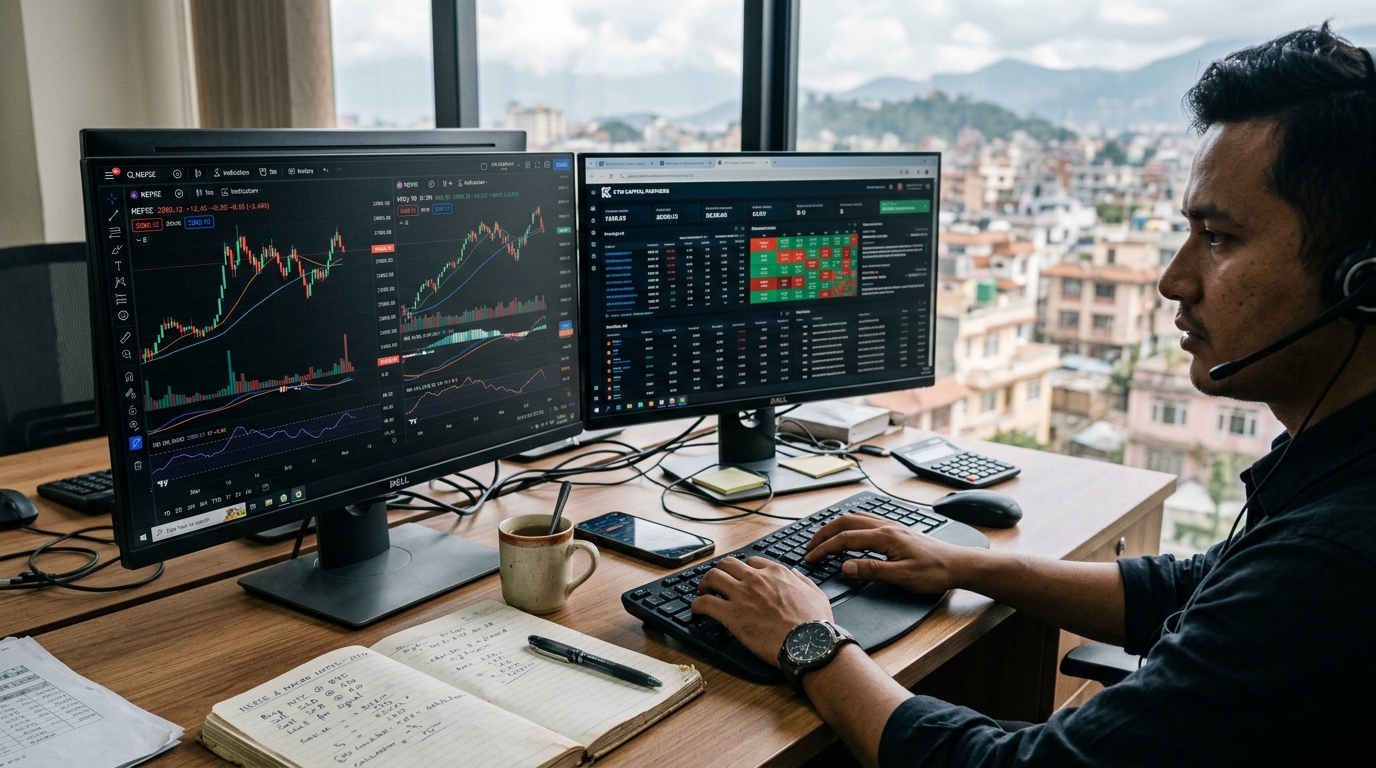
Scroll through Nepali finance groups on Viber, Facebook, or Telegram during trading hours, and you will inevitably encounter bold claims. Individual developers and market commentators regularly promote automated indicators, predictive scripts, or machine learning algorithms promising to forecast the next equity heading for a 10% upper circuit on the Nepal Stock Exchange (NEPSE).
Globally, interest in algorithmic trading continues to expand. Quantitative investment funds, market makers, and retail platforms dedicate significant resources to predictive modeling, natural language sentiment processing, and automated portfolio balancing.
However, financial markets do not behave like closed computational systems. An algorithm engineered to identify statistical arbitrage in the New York Stock Exchange or NASDAQ cannot simply be applied to NEPSE and expected to produce consistent returns.
When investors explore AI NEPSE stock prediction, they frequently mistake technical complexity for market foresight. Artificial intelligence provides genuine utility for financial research in Nepal, but predicting price movements in our domestic market faces structural realities that algorithms cannot bypass.
What AI Tools Actually Do Well in Modern Finance
To understand the practical boundaries of AI tools for Nepal stock market participants, we must recognize what quantitative systems accomplish effectively in mature financial environments.
1. High-Throughput Pattern Recognition
Machine learning algorithms excel at identifying subtle patterns across continuous time-series datasets. Given historical order book data, models can detect statistical tendencies—such as volatility clustering or mean-reversion probabilities—across hundreds of liquid equities simultaneously.
2. Scaled Sentiment and Document Processing
Large language models have accelerated fundamental research. Instead of manually reviewing lengthy quarterly filings, corporate disclosures, and economic bulletins, language models can extract balance sheet figures, calculate key ratios, and evaluate sentiment across financial reporting in seconds.
3. Disciplined Risk Management
Automated systems operate without emotional bias. A rules-based program executes stop-losses consistently, balances position sizes according to predefined risk limits, and tests strategies against historic drawdowns through quantitative backtesting.
These capabilities are valuable. Yet their effectiveness depends on market liquidity, transparent data feeds, and continuous price discovery—conditions that NEPSE does not exhibit.
Why NEPSE Breaks Standard AI Prediction Models
Applying off-the-shelf predictive AI models to NEPSE fails because our market functions under unique operational dynamics. Standard quantitative software struggles with Nepal’s equity environment in four specific ways.
1. Low Liquidity and Thin Floating Shares
Predictive models rely on the assumption of a continuous auction where individual participants cannot arbitrarily move price formation. In NEPSE, many listed companies—particularly small-cap hydropowers, microfinances, and regional firms—have small floating shares.
When a stock trades only a few thousand shares per session, a coordinated syndicate or a single high-net-worth participant placing a substantial order can drive the price to its maximum daily ceiling. AI models cannot predict concentrated buying maneuvers from historical charts because those movements stem from external capital concentration rather than repeatable statistical patterns.
2. The Mechanics of Daily Circuit Breakers
NEPSE enforces a strict $\pm 10%$ daily price limit on individual equities, alongside index-wide circuit halts at 4%, 5%, and 6% movements.
In liquid international markets, assets experiencing unexpected news undergo rapid price re-evaluations across thousands of micro-transactions. In Nepal, when an equity hits its lower circuit limit, liquidity evaporates: buyers vanish, sell orders queue up, and transactions halt.
These circuit mechanics create artificial price gaps and delayed price discovery. Machine learning models trained on continuous distributions cannot model environments where supply or demand completely freezes for multiple days.
3. Retail Dominance and Informal Information Channels
In developed equity markets, institutional capital accounts for most trading volume, guided by quantitative frameworks, regulatory disclosures, and systematic valuation models.
NEPSE remains heavily retail-driven. Much of daily trading volume is influenced by discussions in Clubhouse rooms, closed social media channels, and local brokerage floors. When trading activity responds to speculative herd sentiment rather than audited financial disclosures, language models scanning public news miss the informal catalysts driving market shifts.
4. Data Availability and API Constraints
Effective financial AI requires granular, high-frequency data: tick-by-tick records, Level 2 and Level 3 order book depth, historical bid-ask queues, and standardized corporate filings.
In Nepal, access to historical order book depth is limited. Public market data consists primarily of end-of-day (EOD) Bhavcopy records. Furthermore, quarterly financial disclosures are frequently published as scanned, unstructured PDF images rather than standardized data feeds. Training complex predictive models on sparse end-of-day data produces severe overfitting—memorizing historical noise rather than learning predictive signal.
Comparing AI Predictions: Mature Markets vs. NEPSE Reality
| Analytical Area | Mature Liquid Markets (US/India) | Nepal Stock Exchange (NEPSE) Reality | Practical Advice for Nepali Investors |
|---|---|---|---|
| Price Forecasting | Short-term statistical arbitrage via microsecond latency | Distorted by thin liquidity and concentrated volume | Treat all price-prediction claims with skepticism |
| Technical Analysis | High-frequency execution across deep order books | Standard chart patterns frequently fail around circuit limits | Use indicators for risk control, not automatic trade triggers |
| Sentiment Analysis | Automated ingestion of SEC filings and wire feeds | Catalysts circulate through private chat groups and forums | Use AI to summarize public news, but verify rumors independently |
| Data Quality | Sub-millisecond tick data with full order book depth | End-of-day summaries with limited historical depth | Avoid training complex deep learning models on noisy EOD data |
| Regulatory Factor | Gradual interest rate adjustments and open short-selling | Sudden policy directives (margin lending caps, CD ratios) | Prioritize macroeconomic policy monitoring over chart algorithms |
What a Nepali Investor Can Realistically Use AI For Today
Recognizing that AI cannot forecast closing prices does not mean technology has no value. When approaching AI investing Nepal with realistic expectations, modern tools can upgrade your research workflow.
1. Accelerating Fundamental Financial Analysis
Instead of spending an evening parsing a commercial bank’s 60-page quarterly balance sheet, you can use AI tools to extract:
- Changes in non-performing loans (NPL) and loan-loss provisions.
- Year-over-year net interest margin growth.
- Capital adequacy ratios and cost of funds trajectories.
AI does not determine whether an equity is an automatic buy; it provides structured, objective data so you can evaluate the business effectively.
2. Systematic Backtesting of Risk Rules
Rather than guessing whether a technical indicator works, you can use Python with basic data libraries to test rules on historical Bhavcopy data:
- What was the historical drawdown of buying equities after their 14-day RSI fell below 30?
- Did holding commercial banks through monetary policy announcements offer favorable risk-adjusted returns?
Testing assumptions prevents you from chasing speculative rallies without an exit strategy.
3. Automated Watchlists and Filing Alerts
Basic automation scripts can send notifications when companies on your watchlist publish AGM notices, dividend proposals, or quarterly reports, eliminating the need to refresh news portals manually throughout the day.
What to Be Extremely Skeptical Of
Protecting your capital in NEPSE requires knowing which marketing claims to reject:
- Guaranteed Circuit Predictors: Software claiming an 80%+ win rate on NEPSE upper circuits is unrealistic. If an algorithm possessed that accuracy, the creator would trade it privately rather than selling it for a nominal fee on social media.
- Automated Social Signal Bots: Predictive bots that circulate buy recommendations often serve as exit-liquidity channels for coordinated groups seeking retail buyers.
- Overfitted Backtests: Beware of technical charts displaying flawless historical performance. Fitting excessive parameters to limited historical data creates an illusion of certainty that fails in live trading.
Conclusion: A Research Assistant, Not an Oracle
Artificial intelligence is transforming research, document summarization, and portfolio risk tracking. However, it is not a crystal ball.
In a market like NEPSE—shaped by regulatory circulars from Nepal Rastra Bank, liquidity bottlenecks, and retail psychology—no algorithm can predict market tops and bottoms with precision. Successful investing in Nepal relies on thorough fundamental analysis, an understanding of credit cycles, strict risk management, and emotional discipline.
Use AI to read faster, organize data cleanly, and verify historical patterns. Leave price prediction claims to speculators.
Disclaimer: This article is strictly for educational and informational purposes and does not constitute financial, investment, or trading advice. Securities trading on the Nepal Stock Exchange involves risk of financial loss. Always conduct independent research and consult a licensed professional before making investment decisions.