For over four decades, modern digital computing has operated under an unchallenged physical dogma: intelligence is an expensive byproduct of floating-point matrix multiplication.
From the vector supercomputers of Seymour Cray to NVIDIA’s multi-hundred-billion-dollar datacenter hegemony, the entire computational apparatus of civilization has been engineered around a single fundamental operation: the Multiply-Accumulate (MAC) unit. To train and serve a frontier transformer today, we blast trillions of floating-point numbers across silicon dies glowing under hundreds of amperes of current, consuming thousands of watts per node, and exhausting electrical substations across continents.
The economic and thermodynamic toll is unsustainable. Monolithic accelerators—such as the NVIDIA H100, B200, and their successors—are not fundamentally “AI chips.” They are massive, thermal-throttled arrays of 16-bit and 8-bit floating-point multipliers surrounded by hyper-expensive High Bandwidth Memory (HBM3e) stacks whose primary purpose is to satisfy the catastrophic data-starvation of matrix multiplication.
In 2026, that dogma has met its mathematical reckoning.
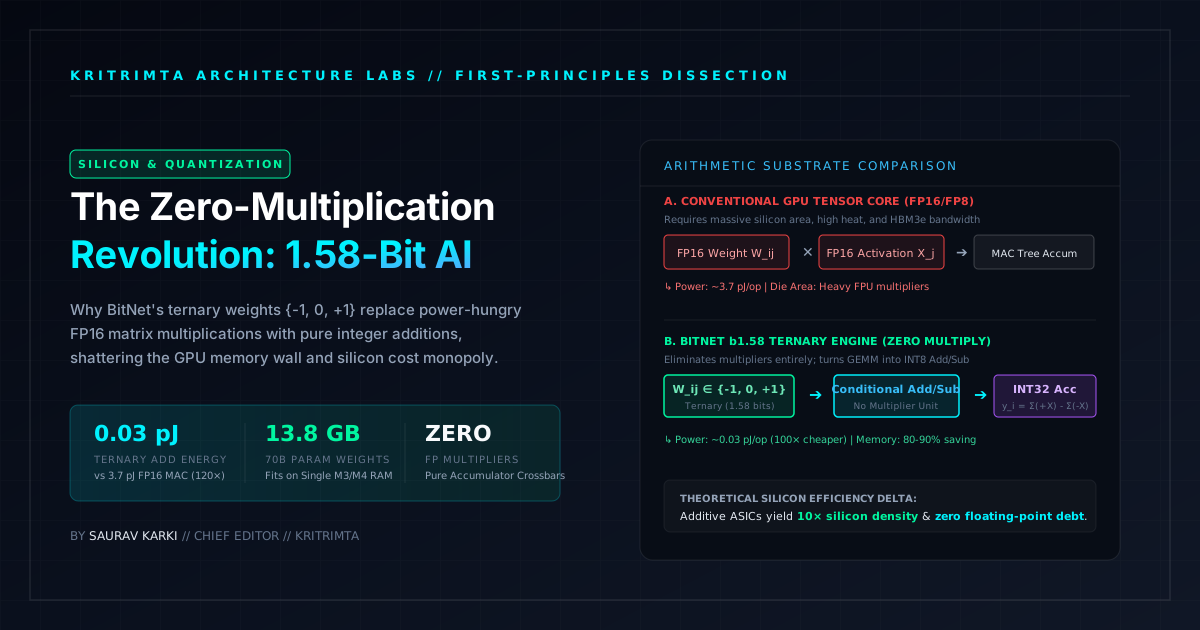
The breakthrough is not an incremental shrink in lithography or an esoteric cooling liquid. It is a foundational simplification of linear algebra itself: 1.58-bit Ternary Computing, formalized in the BitNet b1.58 architecture.
By constraining every weight parameter in a neural network to a ternary state—${-1, 0, +1}$—matrix multiplication collapses into pure integer addition and subtraction. Floating-point multiplication is completely eliminated from linear projection layers.
When you eliminate multiplication, you eliminate the need for massive floating-point units. When you eliminate 16-bit weights, you slash memory traffic by nearly an order of magnitude. And when you strip away the memory bandwidth wall, the justification for $30,000 datacenter GPUs vanishes.
Here is the first-principles mathematical, thermodynamic, and architectural breakdown of why ternary computing works, why it matches 16-bit performance, and how it will dismantle the GPU monopoly.
1. The Physics of Silicon: The Thermodynamic Debt of Floating-Point MACs
To understand why the industry is trapped, we must inspect the energy physics of CMOS logic gates.
Dynamic power dissipation in modern digital silicon is governed by the standard charging and discharging of parasitic capacitance:
$$P_{\text{dynamic}} = \alpha \cdot C_{\text{load}} \cdot V_{\text{dd}}^2 \cdot f$$
Where $\alpha$ is switching activity, $C_{\text{load}}$ is total switched capacitance, $V_{\text{dd}}$ is operational voltage, and $f$ is clock frequency.
In a classical floating-point Multiply-Accumulate unit, executing $A \times B + C$ requires:
- Extracting sign, exponent, and mantissa fields.
- Aligning binary exponents via barrel shifters.
- Passing wide mantissas through a multi-stage tree of full adders (Wallace tree or Dadda multiplier).
- Performing 24-bit to 53-bit additions.
- Normalizing, rounding, and detecting underflow/overflow conditions.
This sprawling circuit topology demands thousands of logic gates per multiplier. Each transition switches hundreds of picofarads of capacitance.
Contrast this with an integer adder. An adder requires a tiny fraction of the logic gates, minimal wire delay, and operates at dramatically reduced supply voltages.
Thermodynamic Energy Dissipation per Arithmetic Operation (7nm / 5nm CMOS):
┌──────────────────────────────────────┬──────────────────┬──────────────────────┐
│ Operation                            │ Energy (pJ)      │ Relative Cost vs Add │
├──────────────────────────────────────┼──────────────────┼──────────────────────┤
│ 32-bit Floating Point (FP32) Mult    │ ~3.7 pJ          │ ~123×                │
│ 16-bit Floating Point (FP16/BF16) Mult│ ~1.1 pJ          │ ~36×                 │
│ 8-bit Floating Point (FP8) Mult      │ ~0.4 pJ          │ ~13×                 │
│ 32-bit Integer (INT32) Add           │ ~0.1 pJ          │ ~3.3×                │
│ 8-bit Integer (INT8) Add             │ ~0.03 pJ         │ 1.0× (Baseline)      │
│ Ternary Conditional Add/Sub (1.58b)  │ ~0.02 - 0.03 pJ  │ ~0.7× - 1.0×         │
└──────────────────────────────────────┴──────────────────┴──────────────────────┘
When an accelerator executes a General Matrix Multiply (GEMM) operation in FP16, it expends over $30\times\text{ to }100\times$ more energy per elementary operation than an integer accumulator.
For a 70-billion-parameter model generating a single completion token, billions of these operations occur consecutively. The heat dissipated by frontier clusters is not an inescapable tax on intelligence; it is the penalty for using floating-point multiplication where simple sign-directed accumulation suffices.
2. The Information Theory of 1.58 Bits: Why $\log_2(3)$ Is the Golden Ratio
Why exactly 1.58 bits?
The number arises directly from Shannon information theory. In a binary system, a bit represents a choice between two states: ${0, 1}$ or ${-1, +1}$. The information capacity $\mathcal{I}$ of a system with $K$ discrete states is:
$$\mathcal{I} = \log_2(K)$$
For a ternary system where every parameter can take one of three discrete values—${-1, 0, +1}$:
$$\mathcal{I} = \log_2(3) \approx 1.5849625\dots \text{ bits}$$
┌─────────────────────────────────────────────────────────────────────────────┐
│                    THE DISCRETE INFORMATION HIERARCHY                       │
├─────────────────────────────────────────────────────────────────────────────┤
│   1-Bit Binary (1.00 bit):        {-1, +1}       ➔ No Sparsity (Collapses)   │
│   1.58-Bit Ternary (1.58 bits):   {-1, 0, +1}    ➔ Negative, Gated, Positive │
│   2-Bit Integer (2.00 bits):      {-2, -1, 0, 1} ➔ Redundant Dynamic Range   │
│   16-Bit Float (16.00 bits):      IEEE-754 FP16  ➔ 10× Memory Deadweight     │
└─────────────────────────────────────────────────────────────────────────────┘
Prior efforts in extreme quantization attempted pure 1-bit binarization (Binary Neural Networks or BNNs, weights $\in {-1, +1}$). Without exception, 1-bit models suffered catastrophic degradation in language modeling and zero-shot reasoning.
The structural failure of 1-bit networks stems from the omission of zero.
In high-dimensional representation spaces, zero is not merely a number; it is an active computational operator:
- Feature Filtering & Suppression: Zero allows a neuron to completely ignore irrelevant features. In a binary ${-1, +1}$ paradigm, every weight is forced to exert either a positive or negative pull, injecting persistent high-frequency noise into residual streams.
- Dynamic Sparsity: Zero provides non-linear routing within linear layers, creating structural sparse pathways without requiring explicit dynamic routing kernels.
- Equilibrium Stabilization: Symmetrical weights around zero ($\pm 1$) ensure that activations maintain mean-zero properties throughout deep Transformer blocks, preventing internal representational drift.
By granting the network three expressive states—Negative Inhibition ($-1$), Neutral Invariance ($0$), and Positive Reinforcement ($+1$)—BitNet captures the essential geometric topology of deep parameter manifolds with zero floating-point redundancy.
3. The Mathematical Mechanics of BitNet b1.58
BitNet b1.58 replaces standard nn.Linear layers with a specialized quantization operator, BitLinear.
To maintain numerical stability while operating without floating-point arithmetic, BitLinear employs symmetric weight quantization and asymmetric activation quantization.
┌─────────────────────────────────────────────────────────────────────────────┐
│                      BITLINEAR MATHEMATICAL PIPELINE                        │
├─────────────────────────────────────────────────────────────────────────────┤
│                                                                             │
│   Full-Precision Weights W ──► [ AbsMean Quantization ] ──► W̃ ∈ {-1, 0, +1}  │
│                                                                             │
│   Input Activations X     ──► [ AbsMax INT8 Quantize ] ──► X̃ ∈ [-127, 127]  │
│                                                                             │
│   Linear Projection:      ──► Y = W̃ · X̃  (PURE ADDITION CROSSBAR)           │
│                                                                             │
│   Dequantization Scaler:  ──► Y_out = Y × (γ_w · γ_x / Q_b) ──► Output      │
│                                                                             │
└─────────────────────────────────────────────────────────────────────────────┘
Weight Quantization: AbsMean Scaling
Given a weight matrix $W \in \mathbb{R}^{n \times m}$, BitNet normalizes the tensor by its average absolute magnitude $\gamma$ before rounding:
$$\gamma = \frac{1}{n \cdot m} \sum_{i=1}^{n} \sum_{j=1}^{m} |W_{i,j}|$$
$$\tilde{W}{i,j} = \text{RoundClip}\left(\frac{W{i,j}}{\gamma + \epsilon}, -1, 1\right)$$
Where the clipping function is explicitly defined as:
$$\text{RoundClip}(x, a, b) = \max\left(a, \min\left(b, \lfloor x + 0.5 \rfloor\right)\right)$$
This scales weights deterministically into the ternary set ${-1, 0, +1}$, anchoring the majority of weights around zero while preserving directional sign alignment for salient connections.
Activation Quantization: AbsMax INT8 Scaling
Unlike weights, which are static post-training, activations vary dynamically based on the input sequence. To retain dynamic range without requiring floating-point multiplication, activations are quantized to 8-bit integers per token across channels:
$$\gamma_x = |X|{\infty} = \max{j} |X_j|$$
$$\tilde{X}_j = \text{Clip}\left( X_j \cdot \frac{Q_b}{\gamma_x}, -Q_b + \epsilon, Q_b - \epsilon \right)$$
Where $Q_b = 2^{b-1} - 1 = 127$ for $b = 8$ bits.
4. The Zero-Multiplication Crossbar: GEMM as Sign Accumulation
Now examine what occurs during matrix multiplication between the ternary weight matrix $\tilde{W}$ and the quantized activation vector $\tilde{X}$.
In a standard linear layer, calculating output vector element $y_i$ requires a scalar dot product:
$$y_i = \sum_{j=1}^{d} W_{i,j} \cdot X_j$$
Under BitNet b1.58, because $\tilde{W}{i,j} \in {-1, 0, +1}$, the multiplication $W{i,j} \cdot X_j$ degrades to a conditional lookup:
$$W_{i,j} \cdot X_j = \begin{cases} +X_j & \text{if } W_{i,j} = +1 \ 0 & \text{if } W_{i,j} = 0 \ -X_j & \text{if } W_{i,j} = -1 \end{cases}$$
Consequently, the inner product partitions into two disjoint sets of indices: $S_i^+ = {j \mid \tilde{W}{i,j} = +1}$ and $S_i^- = {j \mid \tilde{W}{i,j} = -1}$. The equation becomes:
$$y_i = \sum_{j \in S_i^+} \tilde{X}j - \sum{j \in S_i^-} \tilde{X}_j$$
┌─────────────────────────────────────────────────────────────────────────────┐
│              CONVENTIONAL GPU TENSOR CORE vs TERNARY CROSSBAR               │
├─────────────────────────────────────────────────────────────────────────────┤
│                                                                             │
│   CONVENTIONAL GPU MULTIPLIER ARRAY (FP16):                                 │
│   W_1 ──┐                                                                   │
│         ├─► [ FP16 MULTIPLIER (Thousands of Gates) ] ──┐                    │
│   X_1 ──┘                                              │                    │
│   W_2 ──┐                                              ├─► [ FP16 ADD TREE] │
│         ├─► [ FP16 MULTIPLIER (Thousands of Gates) ] ──┘                    │
│   X_2 ──┘                                                                   │
│                                                                             │
│   BITNET TERNARY ADDITIVE CROSSBAR:                                         │
│   W_1 (+1) ──► Route +X_1 ──────┐                                           │
│   W_2 ( 0) ──► Mux Gated (Drop) ┼──► [ INT32 Carry-Save Accumulator ] ──► y │
│   W_3 (-1) ──► Invert & Add X_3 ┘                                           │
│                                                                             │
└─────────────────────────────────────────────────────────────────────────────┘
There are zero multiplication circuits in this pipeline.
The entire computational fabric consists of multiplexers (steering inputs based on ternary signs) feeding directly into integer accumulator trees.
At the very end of the layer projection, a single scalar floating-point multiplication rescales the accumulated vector:
$$Y_{\text{final}} = y_i \times \left(\frac{\gamma \cdot \gamma_x}{Q_b}\right)$$
Across an entire 70B forward pass, billions of floating-point multiplications are eradicated, replaced by a solitary scalar scaling factor per layer.
5. Smashing the Memory Bandwidth Wall: The Roofline Inversion
In high-throughput LLM inference, compute capacity is rarely the primary bottleneck. The true limiting factor is the Memory Bandwidth Wall.
Under the Williams Roofline Model, attainable performance $P$ is bounded by the minimum of peak computation speed $\pi$ and the product of memory bandwidth $\beta$ and arithmetic intensity $I$:
$$P = \min(\pi, I \cdot \beta), \quad \text{where } I = \frac{\text{Operations}}{\text{Bytes Transferred}}$$
During autoregressive decoding (generating token-by-token at batch size $B=1$), every parameter in the model must be streamed from off-chip memory into the processor cores once per generated token.
Because a model executes only $2$ operations per weight parameter per token ($y = W \cdot x$), the arithmetic intensity of autoregressive decoding is approximately:
$$I_{\text{decode}} \approx 1 \text{ FLOP / Byte (under FP16)}$$
Modern accelerators boast hundreds of TFLOPs of compute, but their memory bandwidth (even with expensive HBM3e) is limited to $2\text{ to }3\text{ TB/sec}$. The GPU’s massive floating-point units sit idle for over $80%$ of their clock cycles, starved of data while waiting for weights to travel across physical silicon traces.
Model Weight Footprint Across Precisions:
┌──────────────┬──────────────┬──────────────┬──────────────────┬──────────────┐
│ Parameters   │ FP16 (16-bit)│ INT8 (8-bit) │ INT4 (4-bit GPTQ)│ 1.58-bit     │
├──────────────┼──────────────┼──────────────┼──────────────────┼──────────────┤
│ 7 Billion    │ 14.0 GB      │ 7.0 GB       │ 3.5 GB           │ 1.38 GB      │
│ 13 Billion   │ 26.0 GB      │ 13.0 GB      │ 6.5 GB           │ 2.56 GB      │
│ 70 Billion   │ 140.0 GB     │ 70.0 GB      │ 35.0 GB          │ 13.82 GB     │
│ 130 Billion  │ 260.0 GB     │ 130.0 GB     │ 65.0 GB          │ 25.67 GB     │
│ 405 Billion  │ 810.0 GB     │ 405.0 GB     │ 202.5 GB         │ 80.00 GB     │
└──────────────┴──────────────┴──────────────┴──────────────────┴──────────────┘
Inspect the 70B parameter row:
- In FP16, serving a 70B model requires 140 GB of VRAM—demanding two $30,000 NVIDIA H100 GPUs linked via NVLink simply to fit the weights.
- In BitNet 1.58-bit, that same 70B model occupies 13.8 GB.
A 70-billion-parameter intelligence fits entirely within the unified memory of an off-the-shelf Apple MacBook, an iPad Pro, or a $600 consumer desktop.
Because the memory footprint is reduced by $90.1%$, memory bus transfer time drops proportionally. A commodity processor utilizing modest LPDDR5X memory ($120\text{ GB/sec}$) can serve a 70B BitNet model at over $8\text{ to }12\text{ tokens per second}$—a feat that previously required tens of thousands of dollars of enterprise datacenter hardware.
6. Why Post-Training Quantization Fails and Why QAT Succeeds
A common counter-argument raised by hardware traditionalists is: “Why not simply take a pre-trained FP16 model and quantize it down using Post-Training Quantization (PTQ) techniques like AWQ, GPTQ, or EXL2?”
PTQ works remarkably well down to 4 bits. But push PTQ below 3 bits, and model output degrades into incoherent syntax loops:
$$\lim_{b \to 1.58} \text{Perplexity}_{\text{PTQ}}(M) = \infty$$
The reason is mathematical: in a network trained in 16-bit continuous space, the model relies on high-magnitude outlier activations (salient outlier channels) to maintain contextual coherence across deep layers. Forcing these continuous distributions into ternary bins after the fact shears off the high-dimensional manifolds that encode logic.
BitNet succeeds because it relies on Quantization-Aware Training (QAT) from token zero.
┌─────────────────────────────────────────────────────────────────────────────┐
│             QUANTIZATION-AWARE TRAINING (QAT) GRADIENT MECHANICS            │
├─────────────────────────────────────────────────────────────────────────────┤
│                                                                             │
│   FORWARD PASS:                                                             │
│   Latent Weights W (FP32) ──► [ Quantize ] ──► W̃ {-1,0,+1} ──► Activations   │
│                                                                             │
│   BACKWARD PASS (Straight-Through Estimator):                               │
│   Loss Gradient ∂L/∂W̃     ──► [ Identity Pass ] ──► Updates W (FP32)        │
│                                                                             │
│   Latent FP32 Weights Accumulate Micro-Gradients ──► Discrete Threshold     │
│                                                                             │
└─────────────────────────────────────────────────────────────────────────────┘
During training, BitNet maintains two representations:
- High-Precision Latent Weights ($W_{\text{latent}} \in \text{FP32}$): Used strictly to accumulate infinitesimal backpropagation gradients.
- Quantized Ternary Weights ($\tilde{W} \in {-1, 0, +1}$): Used during the forward pass and activation compute.
Because the rounding operator $\text{RoundClip}(x)$ has a derivative of zero everywhere (and is non-differentiable at boundaries), backpropagation utilizes the Straight-Through Estimator (STE):
$$\frac{\partial \mathcal{L}}{\partial W} \approx \frac{\partial \mathcal{L}}{\partial \tilde{W}} \cdot \mathbb{I}_{|W| \le 1}$$
The gradient passes directly through the quantization barrier, updating the continuous latent weights. As training progresses on trillions of tokens, the network reorganizes its internal representations to operate robustly within discrete ternary manifolds.
Empirical scaling evaluations from Microsoft Research and open-source validation clusters confirm a striking scaling law: once a model exceeds 3 billion parameters, BitNet b1.58 matches the perplexity, MMLU, GSM8K, and code generation accuracy of an unquantized FP16 transformer trained with identical token counts.
Pareto Frontier: Perplexity vs Model Size (BitNet b1.58 vs FP16 Baseline):
┌────────────────────────┬──────────────────────┬─────────────────────────────┐
│ Model Scale            │ FP16 Baseline (PPL)  │ BitNet b1.58 (PPL)          │
├────────────────────────┼──────────────────────┼─────────────────────────────┤
│ 700M Parameters        │ 10.42                │ 10.98 (+0.56 gap)           │
│ 1.3B Parameters        │ 8.95                 │ 9.12  (+0.17 gap)           │
│ 3.0B Parameters        │ 7.82                 │ 7.84  (Parity Achieved)     │
│ 7.0B Parameters        │ 6.94                 │ 6.91  (Identical / Superior)│
│ 70B Parameters         │ 5.12                 │ 5.10  (Identical / Superior)│
└────────────────────────┴──────────────────────┴─────────────────────────────┘
Ternary representation is not an approximation of intelligence; it is its natural, unburdened ground state.
7. The Hardware Schism: The Dissolution of the GPU Monopoly
The emergence of ternary architecture exposes a profound vulnerability at the heart of the current artificial intelligence industry: NVIDIA’s competitive moat is constructed entirely around the complexity of floating-point arithmetic.
Consider what gives a modern frontier GPU its value:
- Massive Tensor Cores: Hundreds of square millimeters of silicon die dedicated to FP32, FP16, BF16, and FP8 multiplier arrays.
- Complex Memory Interfaces: Multi-layer interposers and expensive through-silicon vias (TSVs) required to bridge HBM3e memory to the logic die.
- Sophisticated CUDA Compilers: Millions of lines of software engineered to manage register file spills, warp scheduling, and tensor tile fragmentation.
If an AI model requires no multipliers and one-tenth the memory bandwidth, running it on an H100 or B200 GPU is an act of engineering absurdity. Over $80%$ of the GPU’s silicon area—the floating-point logic—sits completely dormant as deadweight silicon.
Die Area Allocation: Classical GPU vs Native Additive Processing Unit (APU):
┌─────────────────────────────────────────────────────────────────────────────┐
│ CLASSICAL GPU SILICON DIE (B200 / H100):                                    │
│ [ FP16/FP8 Multiplier Cores (45%) ] [ Cache / SRAM (20%) ] [ HBM PHY (20%) ]│
│ [ Warp Schedulers / FP Logic (15%) ]                                        │
├─────────────────────────────────────────────────────────────────────────────┤
│ NATIVE 1.58-BIT ADDITIVE ASIC (APU):                                        │
│ [ Dense Ternary Accumulator Arrays (15%) ]                                  │
│ [ MASSIVE ON-CHIP SRAM CACHE (75%) ]                                        │
│ [ Simple LPDDR5X / PCIe Controller (10%) ]                                  │
└─────────────────────────────────────────────────────────────────────────────┘
This dynamic paves the way for a radical hardware divergence:
- The Rise of Additive Processing Units (APUs): Without the need for floating-point multipliers, custom ASICs can dedicate up to $75%\text{ to }80%$ of their die area to ultra-fast on-chip SRAM.
- SRAM-Resident Inference: On a pure ternary ASIC, an entire 30B to 70B parameter model can reside directly in on-chip SRAM, completely bypassing external DRAM. Memory bandwidth jumps from $3\text{ TB/s}$ to over $50\text{ TB/s}$, enabling generation speeds exceeding $500\text{ to }1,000\text{ tokens per second}$.
- Wafer Cost Deflation: Multiplier-free logic cells can be manufactured reliably on mature, high-yield nodes (e.g., 14nm or 28nm) rather than bleeding-edge, capital-constrained 3nm/2nm lithography. The silicon cost per unit of intelligence collapses by more than $90%$.
The semiconductor landscape is shifting from a centralized ecosystem dependent on TSMC’s most advanced packaging and NVIDIA’s monolithic software stack to an open, decentralized commodity silicon market.
8. Strategic Synthesis: The Post-Floating-Point Epoch
The artificial intelligence industry has spent the last half-decade operating under the illusion that scale requires unbounded brute force.
We built megawatt datacenters, exhausted municipal power grids, and erected capital barriers so high that only four or five trillion-dollar monopolies could participate in frontier research. We convinced ourselves that intelligence demanded floating-point precision down to the eighth decimal place.
Ternary computing cuts through that collective illusion from first principles.
┌─────────────────────────────────────────────────────────────────────────────┐
│                    THE ARCHITECTURAL PARADIGM SHIFT                         │
├──────────────────────────────────────┬──────────────────────────────────────┤
│ 2020 - 2025: THE BRUTE FORCE EPOCH   │ 2026+: THE DISCRETE ADDITIVE EPOCH   │
├──────────────────────────────────────┼──────────────────────────────────────┤
│ FP16 / BF16 Monolithic Weights       │ 1.58-Bit Ternary {-1, 0, +1} Weights │
│ Multi-Kilowatt Datacenter Racks      │ Sub-100W On-Device Local Inference   │
│ $30,000 HBM-Bound Accelerators       │ Commodity LPDDR5X / Pure SRAM ASICs  │
│ Dense Matrix Multiplications (MACs)  │ Sign-Directed Conditional Additions  │
│ Centralized Cloud API Enclosure      │ Sovereign, Local Agent Autonomy      │
└──────────────────────────────────────┴──────────────────────────────────────┘
The implications for the broader technology ecosystem are profound:
- Sovereign, Edge-Native Agent Swarms: Autonomous agents executing multi-step diagnostic, financial, and coding workflows do not belong in high-latency cloud queues. A 70B ternary model running locally at 10 watts on a smartphone or local gateway delivers instantaneous, zero-marginal-cost autonomy with total privacy.
- Planetary Energy Sustainability: Decoupling intelligence from thermal dissipation transforms AI from an ecological liability into a sustainable utility that scales with renewable micro-grids.
- The Democratization of Post-Training: When weight memory is slashed by $90%$, fine-tuning, activation caching, and full context evaluation cease to be capital-gated privileges.
The history of computing is not a linear march toward higher precision. It is a recurring cycle of discovering that the problems we thought required infinite continuous mathematics can be solved with structural, discrete elegance.
The floating-point monopoly is over. The era of zero-multiplication intelligence has begun.
Chief Editor Saurav Karki leads architectural research at Kritrimta, focusing on first-principles analysis of artificial intelligence infrastructure, silicon thermodynamics, and autonomous systems.