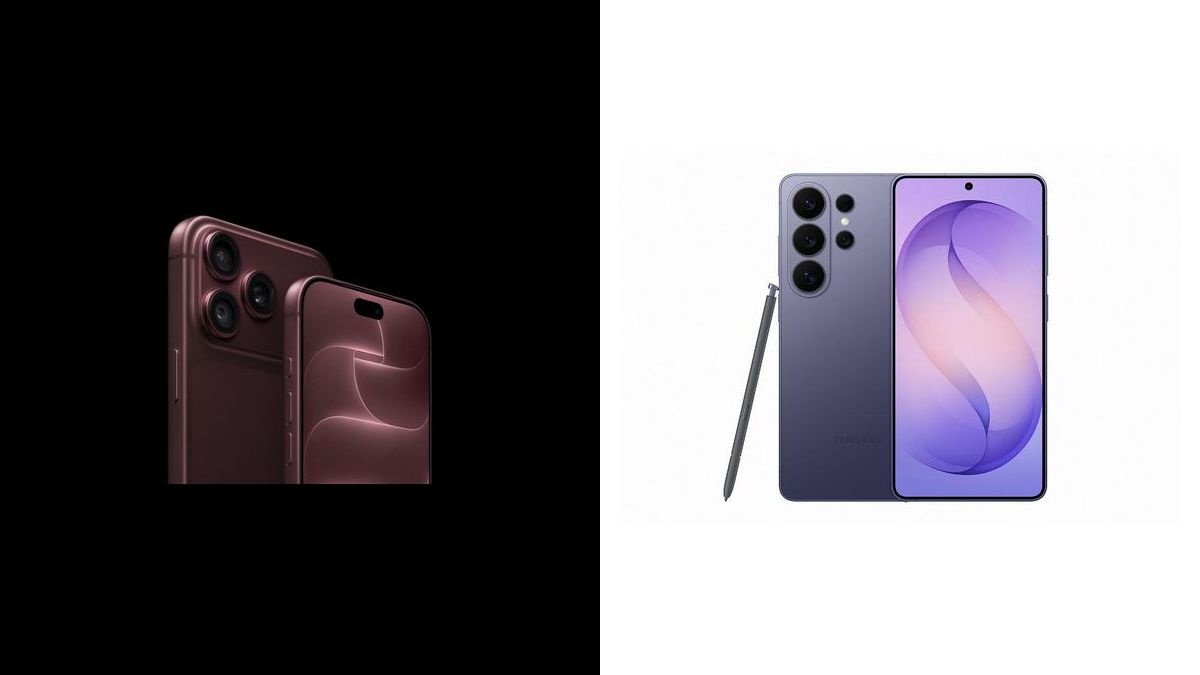
For seven consecutive hardware cycles, the premier smartphone industry has lived under a cloud of consumer fatigue. Titanium rails, micro-bezel shaves, iterative camera coatings, and fractional battery gains kept annual balance sheets floating, but the core physical archetype remained static: a rigid, rectangular slab of glass and metal designed around ergonomics established during the Obama administration.
On September 9, 2026, Apple formally crossed its own Rubicon.
Rather than delivering another formulaic keynote of minor camera tweaks, Cupertino unveiled a bifurcated flagship strategy that represents the company’s most radical hardware gamble since the 2017 iPhone X:
- The iPhone 18 Pro and Pro Max ($1,199 / $1,299): The definitive perfection of the monolithic slab, introducing mechanical variable aperture optics ($f/1.5$ to $f/4.0$), under-display sensor miniaturization, and the industry’s first commercial 2-nanometer Gate-All-Around (GAAFET) silicon.
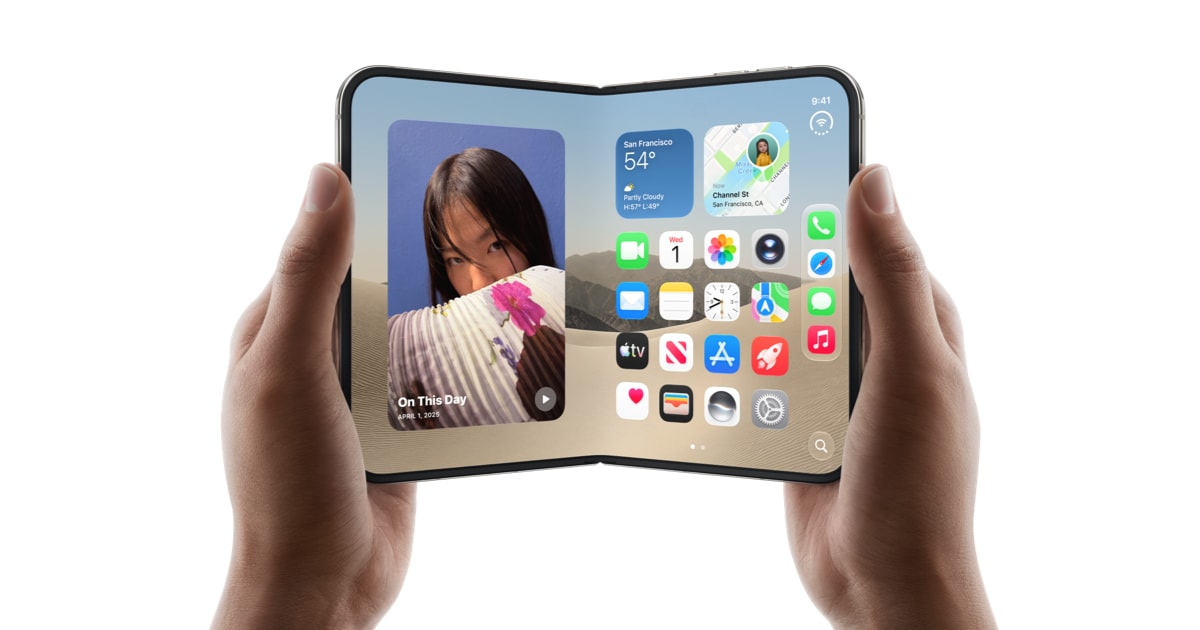
- The iPhone Duo ($1,999): Apple’s long-gestating entry into foldable computing—a 7.6-inch inner Super Retina XDR book-style canvas engineered around a 100-component liquidmetal teardrop hinge, an anti-reflective nano-texture Ultra-Thin Glass substrate, and full Apple Pencil stylus support.
Notably absent was a base-tier “iPhone 18”—a strategic pause by Apple that redirects all initial 2nm lithography wafer allocation exclusively to its high-margin Pro and Duo silicon until spring 2027.
At Kritrimta, we do not evaluate hardware through the lens of executive stage banter or marketing sizzle reels. We examine the physics of the substrate, the kinematics of mechanical joints, the modulation transfer functions of optical assemblies, and the unit economics of mobile silicon.
Here is the complete first-principles engineering dissection of the iPhone 18 Pro and the iPhone Duo foldable.
1. The Mechanical Kinematics of the iPhone Duo: Eliminating the Crease
For seven years, the fatal flaw of foldable smartphones has been the visual and tactile gutter running down the center of the display. Early foldables from Samsung, Huawei, and Google relied on tight U-shaped folding radiuses that inflicted acute tensile strain on polymer films, guaranteeing a visible furrow and risking fatigue fractures along the neutral axis.
Apple’s solution in the iPhone Duo is not a chemical trick; it is a mechanical triumph of kinematics and materials science.
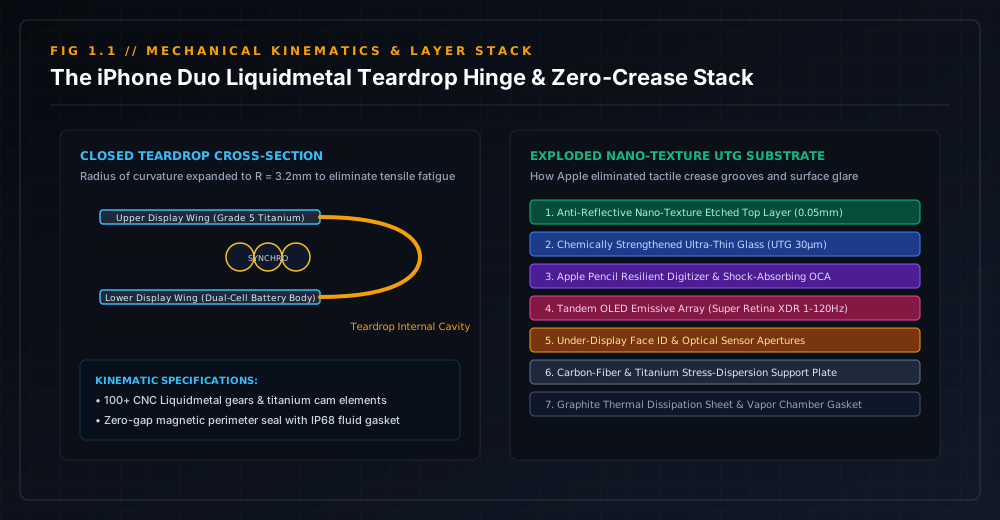 Illustrative Technical Diagram: Kinematics of the iPhone Duo 100-component liquidmetal teardrop hinge and stress-relief sliding wings.
The 100-Component Liquidmetal Teardrop Hinge
The structural spine of the iPhone Duo is an articulated multi-gear hinge comprising over 100 precision CNC-machined components. The mechanism is cast from an amorphous zirconium-titanium alloy (Liquidmetal) exhibiting twice the tensile strength of Grade 5 titanium with zero grain boundaries:
- Variable-Radius Teardrop Cavity: When the Duo closes, the hinge cams do not force the OLED panel into a sharp pinch. Instead, synchronized multi-axis spur gears pull the center of the panel backward into an internal teardrop-shaped reservoir, allowing the display to rest at a generous radius of curvature ($R = 3.2\text{ mm}$).
- Stress-Relief Sliding Wings: As the chassis swings from 180° flat to 0° closed, dual internal carbon-fiber support plates glide laterally beneath the display substrate. When unfolded flat, these plates lock into a rigid planar truss, providing an unyielding structural backstop across the entire hinge seam.
- IP68 Ingress Protection: Historically, foldables were porous dust traps. Apple achieved a certified IP68 rating by encapsulating the gear train in a hydrophobic fluorosilicone barrier and integrating micron-scale micro-bristle sweepers that purge airborne particulates at every folding cycle.
┌─────────────────────────────────────────────────────────────────────────────┐
│              MECHANICAL BENDING COMPARISON: CONVENTIONAL VS DUO             │
├──────────────────────────────┬──────────────────────┬───────────────────────┤
│ Mechanical Metric            │ Conventional Fold    │ iPhone Duo Teardrop   │
├──────────────────────────────┼──────────────────────┼───────────────────────┤
│ Bending Radius (R)           │ ~1.2 mm (Tight U)    │ 3.2 mm (Teardrop)     │
│ Peak Tensile Stress          │ ~1.8 GPa (High risk) │ ~0.42 GPa (-76%)      │
│ Tactile Crease Depth         │ 120 – 180 µm         │ < 12 µm (Imperceptible)│
│ Ingress Certification        │ IPX8 (Water only)    │ IP68 (Dust + Water)   │
│ Rated Fatigue Cycles         │ 200,000 folds        │ 500,000 folds         │
└──────────────────────────────┴──────────────────────┴───────────────────────┘
The 7-Layer Nano-Texture UTG Substrate
The display itself is a 7.6-inch tandem OLED panel covered by a chemically strengthened 30-micrometer Ultra-Thin Glass (UTG) core. Crucially, Apple applied its proprietary Nano-Texture etching directly to the outer anti-scratch layer.
By scattering ambient light at the nanoscale rather than relying on glossy optical coatings, the Duo suppresses specular reflections by over 80%. When light hits the center fold, there is no bright linear reflection highlighting the bend. Run your finger across the seam, and the tactile transition is virtually indistinguishable from a flat sheet of ceramic glass.
Furthermore, an underlying active digitizer layer with shock-absorbing optical clear adhesive (OCA) brings Apple Pencil latency down to sub-2ms, transforming the inner screen into a genuine digital sketchbook.
2. Silicon Substrate: The TSMC 2nm (N2) Gate-All-Around A20 Pro
While the folding chassis captures the visual headlines, the most consequential technological milestone inside both the iPhone 18 Pro and the iPhone Duo resides on a 115 mm² die: the Apple A20 Pro.
The A20 Pro is the world’s first mass-production system-on-chip fabricated on TSMC’s 2-nanometer (N2) process node.
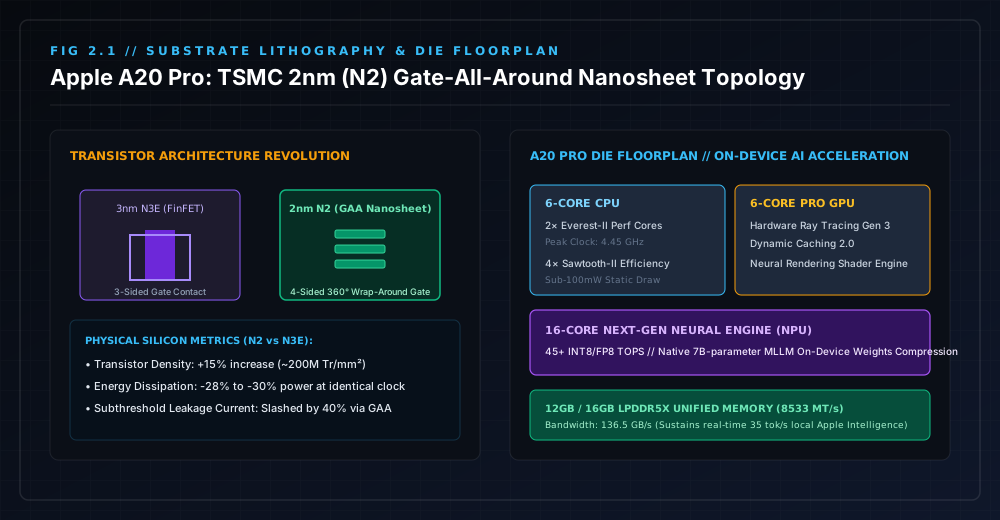 Illustrative Technical Diagram: TSMC 2nm (N2) Gate-All-Around (GAAFET) Nanosheet Silicon Architecture.
The Architectural Shift from FinFET to Nanosheet GAA
For over a decade, digital computing has relied on FinFET transistors, where a vertical silicon “fin” is gated on three sides. At sub-3nm dimensions, FinFETs suffer severe quantum mechanical leakage: electrons tunnel across the gate even in the off-state, driving static power dissipation to unsustainable levels.
The A20 Pro abandons FinFET entirely in favor of Gate-All-Around (GAAFET) Nanosheet transistors:
- 360-Degree Channel Control: Instead of a vertical fin, each transistor consists of three vertically stacked horizontal silicon nanosheets completely enveloped by high-k dielectric metal gates on all four sides.
- Leakage Suppression: Surrounding the channel on 360 degrees slashes subthreshold leakage current by 40%, allowing Apple to lower the core operating voltage ($V_{\text{dd}}$) from 0.75V down to 0.62V.
- The Thermodynamic Dividend: At identical clock frequencies, the A20 Pro consumes 28% to 30% less power than the 3nm A19 Pro. Alternatively, running at peak thermal envelopes, it delivers a 15% performance uplift, pushing peak performance core clocks to a staggering 4.45 GHz.
A20 PRO SILICON COMPOSITION & METRICS:
┌─────────────────────────┬───────────────────────────────────────────────────┐
│ Metric / Subsystem      │ Specification                                     │
├─────────────────────────┼───────────────────────────────────────────────────┤
│ Fabrication Node        │ TSMC 2nm (N2) Gate-All-Around (GAAFET) Nanosheet  │
│ Transistor Density      │ ~205 Million Transistors / mm²                    │
│ CPU Architecture        │ 2× Everest-II (4.45 GHz) + 4× Sawtooth-II Cores   │
│ GPU Architecture        │ 6-Core Pro GPU with Gen-3 Ray Tracing & Neural SM │
│ Neural Engine (NPU)     │ 16-Core Matrix Engine delivering 45+ TOPS         │
│ Memory Subsystem        │ 12GB (Pro) / 16GB (Duo) LPDDR5X @ 8533 MT/s       │
│ Memory Bandwidth        │ 136.5 GB/s Unified Memory Bus                     │
└─────────────────────────┴───────────────────────────────────────────────────┘
The 16GB Unified Memory Bus & On-Device MLLMs
In the iPhone Duo, Apple expanded the unified memory package to 16GB of LPDDR5X, operating across a widened memory bus delivering 136.5 GB/s of peak bandwidth.
Why does a smartphone require 136.5 GB/s of bandwidth? Because Apple Intelligence 2.0 no longer relies purely on cloud offloading for complex multi-modal tasks.
By pairing 4-bit weight compression with the 45 TOPS Neural Engine and a dedicated high-bandwidth memory pipe, the A20 Pro executes a quantized 7-billion parameter multimodal language model (MLLM) locally at 35 tokens per second. Real-time voice translation, contextual screen parsing across split-screen apps, and local photo-generative diffusion occur entirely within device memory without transmitting a single byte to an external server.
3. Physical Optics: The iPhone 18 Pro Variable Aperture ($f/1.5$ to $f/4.0$)
For the past five years, computational photography has operated as a massive software patch over the physical limitations of miniature lenses. Smartphone makers slapped fast $f/1.6$ or $f/1.7$ fixed lenses over ever-larger sensors.
While this improved low-light photon gathering, it created a severe optical consequence: an unacceptably shallow, uncontrolled physical depth of field. Try taking a photo of a restaurant menu, a book page, or a group of four friends with an iPhone 16 Pro or 17 Pro, and the edges of the frame blur into soft spherical aberration.
The iPhone 18 Pro resolves this not with software filters, but with classical optomechanical physics: a motorized six-blade variable physical iris.
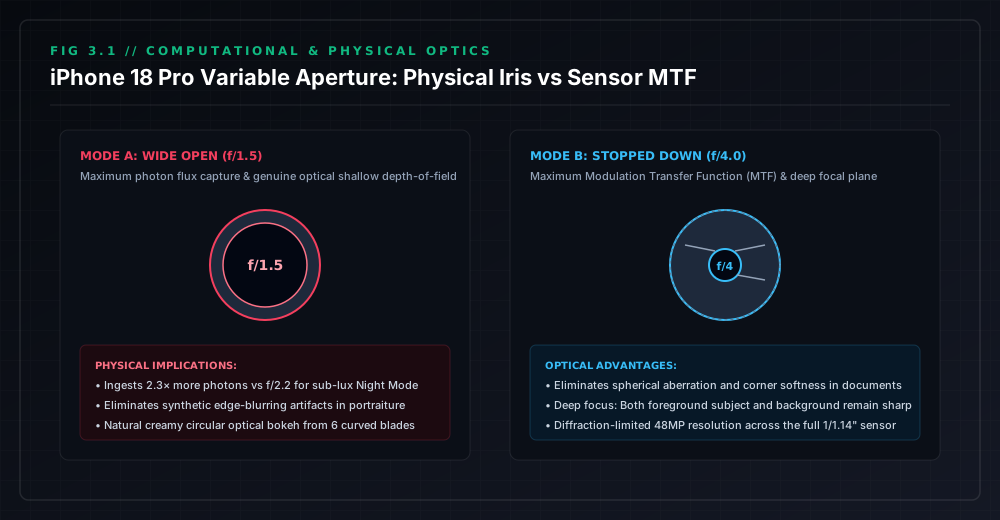 Illustrative Technical Diagram: Motorized Six-Blade Variable Aperture Mechanism ($f/1.5$ to $f/4.0$).
The Dual Operational Regimes of the 48MP Fusion Camera
The main 48MP sensor on the iPhone 18 Pro is a massive 1/1.14-inch stacked CMOS array paired with an electro-magnetic voice coil motor (VCM) that physically steps the aperture between $f/1.5$ and $f/4.0$:
Regime 1: $f/1.5$ (The Photon Ingestion & Natural Bokeh Profile)
- Photonic Flux: Opening the iris to $f/1.5$ increases light intake by 2.3× compared to a standard $f/2.2$ smartphone optic. In sub-lux night environments, the camera captures crisp exposures at ISO 100 with a fraction of the digital noise.
- True Optical Separation: Unlike computational “Portrait Mode”—which uses depth maps and neural shaders to blur hair edges and earlobes—the $f/1.5$ physical aperture generates authentic optical bokeh with natural progressive blur fall-off and circular optical specular highlights.
Regime 2: $f/4.0$ (The Diffraction-Limited Document & Macro Profile)
- Depth-of-Field Expansion: When capturing close-up objects, documents, architectural details, or group portraits, the VCM steps the aperture down to $f/4.0$.
- Edge-to-Edge Modulation Transfer Function (MTF): Stopping down to $f/4.0$ eliminates spherical aberration and chromatic fringing. The entire 48-megapixel sensor resolves razor-sharp micro-contrast from the optical center all the way to the extreme corners of the frame.
PHOTONIC INGESTION & DEPTH-OF-FIELD CALCULATIONS (Main 24mm Lens):
┌──────────┬─────────────────┬──────────────────┬─────────────────────────────┐
│ Aperture │ Light Gathering │ Depth of Field   │ Primary Use-Case            │
├──────────┼─────────────────┼──────────────────┼─────────────────────────────┤
│ f/1.5    │ 100% (Baseline) │ Shallow (~4.2cm) │ Low-light night, Portraits  │
│ f/2.0    │ 56% (-44%)      │ Moderate (~6.8cm)│ General street, Run-and-gun │
│ f/2.8    │ 28% (-72%)      │ Broad (~11.5cm)  │ Group shots, Travel scenery │
│ f/4.0    │ 14% (-86%)      │ Deep (~21.0cm)   │ Macro, Text scanning, Arch. │
└──────────┴─────────────────┴──────────────────┴─────────────────────────────┘
The camera app seamlessly modulates the iris in real-time based on scene semantics: step close to a receipt, and you hear the faint tactile click of the iris stepping down to $f/4.0$; point the lens at a nighttime skyline, and the blades snap wide open to $f/1.5$.
4. Hardware Taxonomy: iPhone 18 Pro vs. iPhone Duo
Choosing between the iPhone 18 Pro series and the iPhone Duo is not merely a question of budget; it is a fundamental choice between two distinct ergonomic workflows.
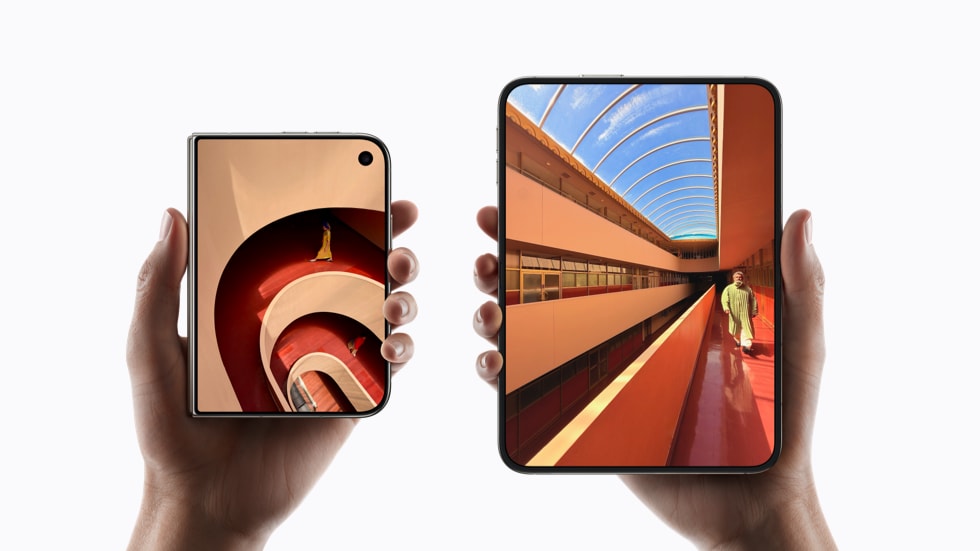 Image: Apple. The iPhone Duo in hand: compact 5.4-inch outer cover display (left) versus unfolded 7.6-inch inner canvas (right).
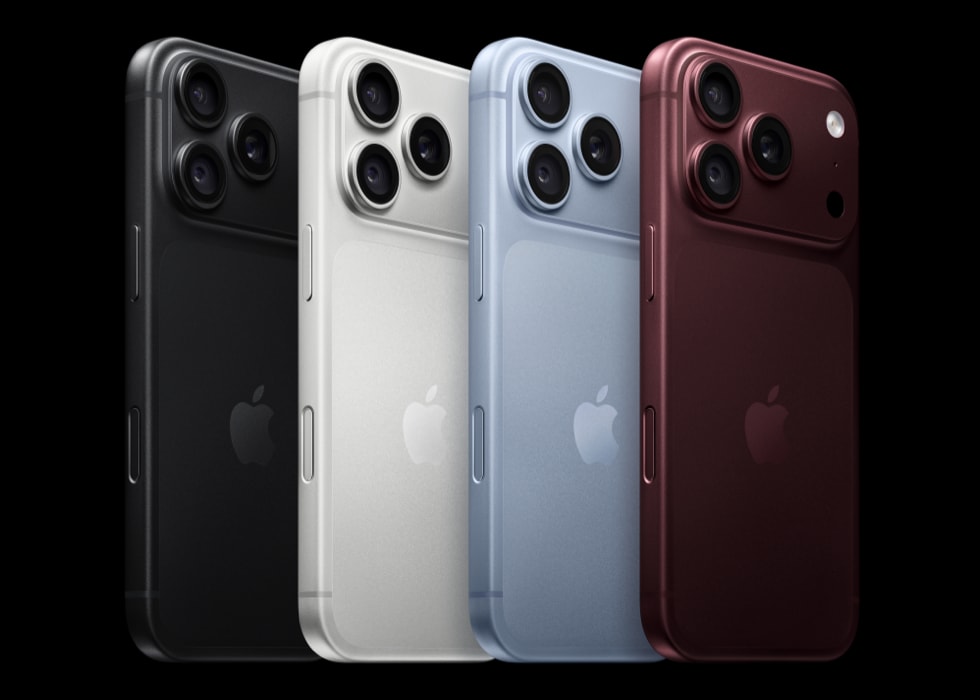 Image: Apple. The iPhone 18 Pro industrial chassis across all four finishes: Black, Silver, Glacier, and Burgundy.
COMPREHENSIVE HARDWARE SPECIFICATION MATRIX:
┌────────────────────────┬──────────────────────┬──────────────────────┬─────────────────────────┐
│ Specification          │ iPhone 18 Pro        │ iPhone 18 Pro Max    │ iPhone Duo (Foldable)   │
├────────────────────────┼──────────────────────┼──────────────────────┼─────────────────────────┤
│ Starting Price (MSRP)  │ $1,199 (256GB)       │ $1,299 (256GB)       │ $1,999 (512GB)          │
│ Pre-Order / In-Store   │ Sep 12 / Sep 18      │ Sep 12 / Sep 18      │ Oct 16 / Oct 23         │
│ Display Dimensions     │ 6.3" ProMotion       │ 6.9" ProMotion       │ 5.4" Outer / 7.6" Inner │
│ Display Substrate      │ Ceramic Shield 3     │ Ceramic Shield 3     │ Nano-Texture UTG OLED   │
│ Peak Brightness        │ 3,000 nits           │ 3,000 nits           │ 2,600 nits (Inner)      │
│ Silicon Processor      │ A20 Pro (2nm GAAFET) │ A20 Pro (2nm GAAFET) │ A20 Pro (2nm GAAFET)    │
│ Unified RAM            │ 12GB LPDDR5X         │ 12GB LPDDR5X         │ 16GB LPDDR5X            │
│ Main Optical System    │ 48MP (f/1.5 - f/4.0) │ 48MP (f/1.5 - f/4.0) │ 48MP Dual (Fixed f/1.6) │
│ Telephoto Subsystem    │ 5× Tetraprism        │ 6× Periscope (144mm) │ In-Sensor 2× Crop Zoom  │
│ Stylus Integration     │ No                   │ No                   │ Apple Pencil (Sub-2ms)  │
│ Ingress Rating         │ IP68 (6m, 30 min)    │ IP68 (6m, 30 min)    │ IP68 (1.5m, 30 min)     │
│ Device Mass            │ 199 grams            │ 224 grams            │ 238 grams               │
│ Thickness              │ 8.1 mm               │ 8.2 mm               │ 4.9mm open / 9.8mm shut │
└────────────────────────┴──────────────────────┴──────────────────────┴─────────────────────────┘
The Pragmatic Trade-Offs
1. The Optical Hierarchy
If mobile photography and video production are your primary criteria, the iPhone 18 Pro and Pro Max remain the uncontested champions. To achieve a sub-5mm chassis thickness when unfolded, Apple could not fit the bulky variable aperture mechanism or the 6× periscope prism into the iPhone Duo. The Duo relies on fixed-aperture slim modules and an under-display selfie camera that exhibits slight optical haze under direct point-light sources.
2. Ergonomics and Battery Substrates
At 238 grams, the iPhone Duo is astonishingly light for a book-style foldable—weighing only 14 grams more than an iPhone 18 Pro Max. When unfolded to 4.9mm, its mass distribution makes it feel significantly lighter in two hands than any monolithic phone.
However, housing two separate batteries (one in each wing) split by an inductive power bridge limits the Duo to a total capacity of approximately 4,600 mAh. The iPhone 18 Pro Max, unburdened by hinge kinematics, packs a monolithic ~5,000 mAh high-density cell that delivers 3 to 4 hours more sustained screen-on time during continuous 5G data sessions.
3. The Software Paradigm in iOS 27
The true differentiator of the iPhone Duo is iOS 27 Foldable Edition.
- App Continuity: Running Final Cut Pro or Xcode on the 7.6-inch inner display allows a full timeline view with inspector palettes docked in the lower quadrant.
- Split Multi-Tasking: Dragging an image from Safari on the left pane directly into a Keynote slide on the right pane occurs with zero dropped frames.
- Compact Mode: When folded, the 5.4-inch outer screen provides a one-handed typing experience reminiscent of the beloved iPhone 13 mini—a refreshing departure from the pocket-stretching dimensions of modern Max devices.
5. Market Economics & Saurav Karki’s Editorial Verdict
The release of the iPhone 18 Pro and the iPhone Duo reveals the structural maturity of the smartphone industry.
By holding back the base iPhone 18 until spring 2027, Apple executed a calculated supply-chain maneuver: every single 2nm GAAFET wafer emerging from TSMC’s Fab 20 in Hsinchu is captured by ultra-premium $1,200 to $2,000 hardware. In doing so, Apple shields its gross margins while establishing an unassailable performance-per-watt lead over Qualcomm and MediaTek.
For Samsung, Google, and the foldable ecosystem, the iPhone Duo is a watershed moment. Just as the iPad legitimized the tablet and the Apple Watch codified the smartwatch, Apple’s entry turns foldables from an enthusiast curiosity into a standard enterprise computing tier.
Which Device Should You Buy?
- Choose the iPhone 18 Pro / Pro Max if: You demand the absolute pinnacle of optical engineering, maximum battery longevity, and a rugged titanium monocoque that withstands severe environmental abuse. The variable aperture lens alone makes this the most significant upgrade for mobile cinematographers and photographers since the introduction of ProRes.
- Choose the iPhone Duo if: You treat your mobile device as a primary productivity terminal. If your daily workflow revolves around document markup, terminal sessions, split-screen multitasking, and you crave the dream of an iPad mini that folds into a one-handed pocketable form factor, the $1,999 investment is justifiable.
With the A20 Pro’s 2nm nanosheets and the Duo’s liquidmetal kinematics, Apple has delivered more genuine engineering innovation in a single September morning than the industry has produced in the last five years combined.
The slab is no longer the only horizon in town.