For five years, the central dogma of generative artificial intelligence rested upon a single, unyielding assumption: intelligence is an asymptotic function of pre-training FLOPs.
From Kaplan’s power laws in 2020 to Chinchilla in 2022, the engineering blueprint remained linear: raise tens of millions, cluster thousands of GPUs, and saturate them with web tokens. Capability was bought through brute force.
In 2026, that paradigm has hit an unforgiving ceiling.
The pre-training frontier has collided with human data exhaustion, synthetic data entropy collapse, and logarithmic decay on capital expenditure. Doubling pre-training compute no longer yields the breathtaking capability leaps that once characterized model transitions.
Yet frontier AI is currently undergoing its most consequential capability inflection since the Transformer’s inception. Systems are solving Olympiad-level mathematics, diagnosing distributed software deadlocks, and discovering novel algorithmic proofs.
This breakthrough did not stem from a 10-trillion parameter dense pre-training run. It emerged from a foundational pivot in computational physics: the shift from pre-training scaling to inference-time compute scaling.
By transforming autoregressive models from single-pass, reflex-driven sequence predictors into dynamic, search-guided deliberative engines, the industry has decoupled complex reasoning from static parameter scale. Here is the first-principles breakdown of the mathematics of test-time compute, the mechanics of Process Reward Models (PRMs), and why the pre-training monopoly is over.
1. The Thermodynamic Exhaustion of the Pre-Training Frontier
To understand why test-time compute is mandatory, we must inspect the limits of pre-training scaling laws.
Under compute-optimal Chinchilla allocations ($C \approx 6ND$), pre-training loss $L$ scales as a power law of parameters $N$ and dataset tokens $D$:
$$L(N, D) = E + \frac{A}{N^\alpha} + \frac{B}{D^\beta}$$
Where $E$ is irreducible entropy, and $\alpha, \beta \approx 0.05 \text{–} 0.1$. This relationship exposes two fatal engineering limits:
Diminishing Returns of Pre-Training FLOP Scaling:
┌───────────────────────────┬────────────────────┬──────────────────────┐
│ Compute Scale (FLOPs)     │ Est. Cluster Cost  │ Marginal Loss Delta  │
├───────────────────────────┼────────────────────┼──────────────────────┤
│ 10²⁴ FLOPs (GPT-3 Era)    │ ~$5M - $10M        │ Base Baseline        │
│ 10²⁵ FLOPs (GPT-4 Era)    │ ~$50M - $100M      │ -0.32 Cross-Entropy  │
│ 10²⁶ FLOPs (Frontier 2025)│ ~$500M - $1B       │ -0.09 Cross-Entropy  │
│ 10²⁷ FLOPs (Hypothetical) │ ~$5B - $10B        │ -0.02 Cross-Entropy  │
└───────────────────────────┴────────────────────┴──────────────────────┘- The Finite Human Token Ceiling: High-quality, linguistically rich human text across the digital commons is bounded at roughly $15\text{ to }20\text{ trillion tokens}$. Once exhausted, recursive training on ungrounded synthetic text triggers entropy collapse: $$H(X_{k+1}) \le H(X_k) - \Delta \epsilon$$ Sampling primarily from high-density distribution modes filters out the improbable tails of human knowledge, degrading variance and amplifying hallucinations.
- The Zero-Margin Problem in Deduction: A cross-entropy loss reduction of $0.05$ improves prose fluency, but in formal logic and mathematics, partial accuracy is total failure. If an autoregressive model predicts 99 correct deductions but diverges on step 100, the output is useless. Pre-training optimizes for average sequence likelihood, not deductive correctness.
2. The Three-Dimensional Scaling Law: Expanding the Compute Envelope
The industry’s conceptual breakthrough is recognizing that compute is not a one-dimensional upfront endowment. Total compute is governed by a three-dimensional vector:
$$C_{\text{total}} = C_{\text{pretrain}} + C_{\text{posttrain}} + C_{\text{test-time}}$$
In standard autoregression, the compute expended generating token $t+1$ is strictly static:
$$\text{FLOPs per token} = 2 \cdot N_{\text{params}}$$
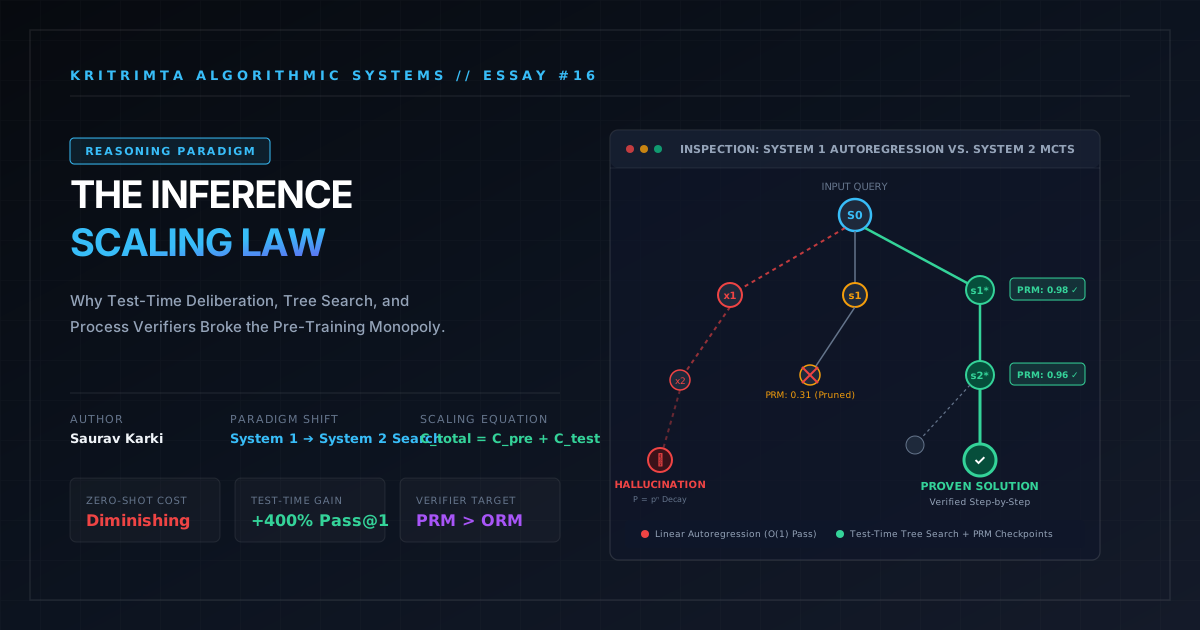
Whether predicting a comma or factoring a prime, the network executes the exact same number of matrix multiplications. This forces the model into Kahneman System 1 thinking: instantaneous, reflexive pattern matching without verification.
By allowing $C_{\text{test-time}}$ to scale dynamically based on problem difficulty, the model transitions to System 2 thinking: iterative hypothesis generation, intermediate verification, backtracking, and search over a latent solution space.
3. The Taxonomy of Test-Time Deliberation: Four Algorithmic Regimes
In contemporary architectures (such as OpenAI o1/o3, DeepSeek R1, and Claude 3.7 Sonnet), inference-time scaling manifests across four distinct algorithmic regimes:
┌─────────────────────────────────────────────────────────────────────────────┐
│                    THE FOUR TEST-TIME COMPUTE REGIMES                       │
├─────────────────────────────────────────────────────────────────────────────┤
│   1. SINGLE-TRAJECTORY DELIBERATION (INTERNAL THINKING TOKENS)              │
│   Prompt ───► [ <think> z₁ ➔ z₂ ➔ ... ➔ z_K </think> ] ───► Solution Y      │
│                                                                             │
│   2. LEAF-LEVEL PARALLEL SAMPLING (BEST-OF-N)                               │
│   Prompt ─┬─► Sample Y₁ ────┐                                               │
│           ├─► Sample Y₂ ────┼──► [ Outcome Verifier (ORM) ] ──► Best Y*     │
│           └─► Sample Y_N ───┘                                               │
│                                                                             │
│   3. SEQUENTIAL GRAPH SEARCH (MCTS & BEAM SEARCH)                           │
│   Prompt ──► State S₀ ──┬─► S₁ ──► [Pruned via Value Network]               │
│                         └─► S₂* ──► S₃* ──► Optimal Verified Path Y*        │
│                                                                             │
│   4. STEP-LEVEL PROCESS SUPERVISION (PROCESS REWARD MODELS)                 │
│   Step s₁ ──► [ PRM: 0.98 ✓ ] ──► Step s₂ ──► [ PRM: 0.22 ✕ PRUNE ]         │
└─────────────────────────────────────────────────────────────────────────────┘
Regime 1: Single-Trajectory Deliberation (Thinking Tokens)
The model emits thousands of intermediate reasoning tokens $Z = (z_1, \dots, z_K)$ within dedicated <think> delimiters prior to the final answer:
$$P(Y \mid X) = \sum_{Z} P(Y \mid X, Z) P(Z \mid X)$$
This effectively performs recurrent depth computation over an expanded context canvas. However, it remains vulnerable to autoregressive self-conditioning: if the model errs at $z_{30}$, subsequent tokens condition on that error, often spending thousands of tokens rationalizing a hallucinated premise.
Regime 2: Leaf-Level Parallel Sampling (Best-of-N)
The engine samples $N$ independent candidate rollouts in parallel:
$$\mathcal{Y} = {y^{(1)}, y^{(2)}, \dots, y^{(N)}} \sim P_\theta(\cdot \mid X)$$
Solutions are ranked via majority voting or an Outcome Reward Model (ORM). While pass@N scales as $1 - (1 - p)^N$, it exhibits sharp diminishing returns: all $N$ paths share the base model’s structural blind spots, simply replicating plausible fallacies at high sampling counts.
Regime 3: Sequential Graph Search (Monte Carlo Tree Search)
Here, reasoning is formulated as a formal search over a Markov Decision Process (MDP), where states $\mathcal{S}$ are sequences of verified steps and actions $\mathcal{A}$ are candidate subsequent steps. Traversal is guided by the Upper Confidence Bound applied to Trees (UCT):
$$\text{UCT}(s, a) = Q(s, a) + c_{\text{puct}} \cdot P(s, a) \frac{\sqrt{\sum_b N(s, b)}}{1 + N(s, a)}$$
When a branch hits low value estimates, the engine backtracks to parent nodes, exploring alternative deductive routes.
Regime 4: Step-Level Process Supervision (PRMs)
The vital engine powering Regime 3 is the evaluator. Rather than scoring complete sequences, a Process Reward Model scores each intermediate deductive step individually, enabling surgical branch pruning.
4. The Credit Assignment Crisis: PRMs vs. Outcome Verifiers
Classical reinforcement learning systems relied on Outcome Reward Models (ORMs) that assign a scalar score only to the terminal answer: $R_{\text{ORM}}(Y \mid X) \in [0, 1]$.
This introduces a catastrophic credit assignment dilemma:
The Credit Assignment Dilemma: ORM vs. PRM
Query: "Solve for x: 3x + 15 = 45"
┌────────────────────────────────────────────────────────────────────────┐
│ Trajectory:                                                            │
│ Step 1: 3x = 45 - 15   ───► Correct algebra                            │
│ Step 2: 3x = 24        ───► [FATAL ERROR: Arithmetic Hallucination]    │
│ Step 3: x = 24 / 3     ───► Correct logic applied to wrong state       │
│ Step 4: x = 10         ───► [LUCKY ERROR: Another hallucination]       │
├────────────────────────────────────────────────────────────────────────┤
│ ORM Evaluation: Terminal answer x = 10 is CORRECT!                     │
│ Reward: R = 1.0 ──► Hallucinated intermediate steps reinforced!        │
├────────────────────────────────────────────────────────────────────────┤
│ PRM Evaluation: Step-by-Step Scoring                                   │
│ Step 1: 0.99 ✓  |  Step 2: 0.02 ✕ ──► PRUNE IMMEDIATELY               │
│ Compute saved; error arrested at the point of origin.                  │
└────────────────────────────────────────────────────────────────────────┘
If an autoregressive chain commits an error on step 2 but lands on the correct terminal output through lucky downstream mistakes, the ORM awards full credit ($R=1.0$), actively training the model to exploit flawed heuristics. Conversely, a 50-step proof containing 49 brilliant steps and one minor typographical error receives $R=0.0$, penalizing valid mathematical reasoning.
A Process Reward Model resolves this by computing step-level conditional probabilities:
$$\text{PRM}(s_t \mid X, s_{1:t-1}) = P(\text{Step } s_t \text{ is logically sound} \mid X, s_{1:t-1})$$
The trajectory validity is the product of its verified transitions:
$$P(\text{Valid}(Y)) = \prod_{t=1}^{T} \sigma\left(\text{PRM}(s_t)\right)$$
If $\text{PRM}(s_t) < \tau$, the search engine immediately terminates the branch, preventing compute waste and eliminating reward hacking.
5. Compute-Optimality & The Inference Pareto Frontier
The deepest economic insight of test-time scaling is that model parameter scale and inference deliberation are interchangeable currencies.
Under fixed inference compute budgets, researchers have mapped the Inference-Time Compute-Optimal Pareto Frontier. Consider operational query cost:
$$\text{Cost}{\text{query}} \approx 2 \cdot N{\text{active}} \cdot (T_{\text{context}} + T_{\text{gen}}) \cdot \kappa$$
Accuracy vs. Total Inference FLOPs on Frontier Math (AIME/Olympiad):
Accuracy (%)
100% ┌───────────────────────────────────────────────────────────────┐
     │                                                               │
 80% │                                          ● 14B + MCTS (PRM)   │
     │                                       ▲                       │
 60% │                         ● 14B + 16k CoT                       │
     │                      ▲                                        │
 40% │       ● 405B Zero-Shot                                        │
     │    ▲                                                          │
 20% │ ● 70B Zero-Shot                                               │
     │                                                               │
  0% └───────────────────────────────────────────────────────────────┘
     10¹¹                  10¹²                  10¹³            FLOPs/Query
Empirical benchmarks demonstrate:
- On symbolic reasoning (AIME, FrontierMath), an 8B or 14B model with PRM-guided tree search consistently outperforms a 405B dense model zero-shot.
- At $\sim 28\text{ GB}$, a 14B model fits in single-socket memory without tensor parallelism latency penalties.
- Expending 4,000 deliberation tokens, it delivers higher accuracy at one-fourth the cost and one-sixth the energy of a 405B cluster emitting 150 tokens.
6. The Pathologies of Deliberation: Overthinking and the Memory Wall
Test-time compute introduces its own distinct architectural bottlenecks:
The “Overthinking” Pathology
Models optimized for deep test-time search frequently fall prey to Goodhart’s Law applied to deliberation length. When asked an elementary factual query (“What is the capital of France?”), the model may over-deliberate:
“The user asks for the capital of France. Paris is standard. But could this refer to Vichy France during WWII? Or the administrative capital of overseas territories? Let me evaluate French constitutional history…”
On simple retrieval tasks, excessive deliberation can reduce accuracy by up to 15–20%, as the model hallucinates phantom edge cases. Production runtimes require dynamic entropy classifiers to bypass deep search on low-complexity prompts.
The KV Cache Memory Explosion
While weights for a 14B model are manageable, branching search causes a severe Key-Value (KV) cache crisis:
$$\text{Memory}{\text{KV}} \propto B \times D \times L \times H \times d{\text{head}}$$
Where $B$ is active branches and $D$ is search depth. Naive branch replication exhausts GPU High-Bandwidth Memory (HBM) in seconds. Solving this requires Radix Tree Attention and Copy-on-Write Paged Attention kernels (such as in vLLM and SGLang), enabling concurrent branches to share immutable prefix cache pointers and duplicate memory pages only upon state divergence.
7. The Editorial Verdict: The Post-Pretraining Era
The generative AI landscape has crossed an irreversible boundary.
The belief that scaling pre-training FLOPs on dense transformers is the singular path to frontier capability is obsolete. Pre-training is becoming a commoditized foundational utility. Base weights are reaching parity; open-weight models routinely match closed checkpoints within months.
The true competitive moat has shifted to the Inference Architecture:
- Discriminative Process Verifiers: The proprietary value lies in the data engines that train infallible, domain-specific Process Reward Models.
- Adaptive Search Topologies: The orchestrators that dynamically route FLOPs between instantaneous reflex and deep Monte Carlo search based on task entropy.
- KV Cache Virtualization: The software and silicon runtimes that execute non-linear tree exploration within physical memory bandwidth constraints.
Intelligence is not a static lookup table etched into silicon weights during pre-training. Intelligence is an active, dynamic thermodynamic search process executed at the moment of inquiry. The pre-training monopoly has fallen; the future belongs to architectures that know how to think.