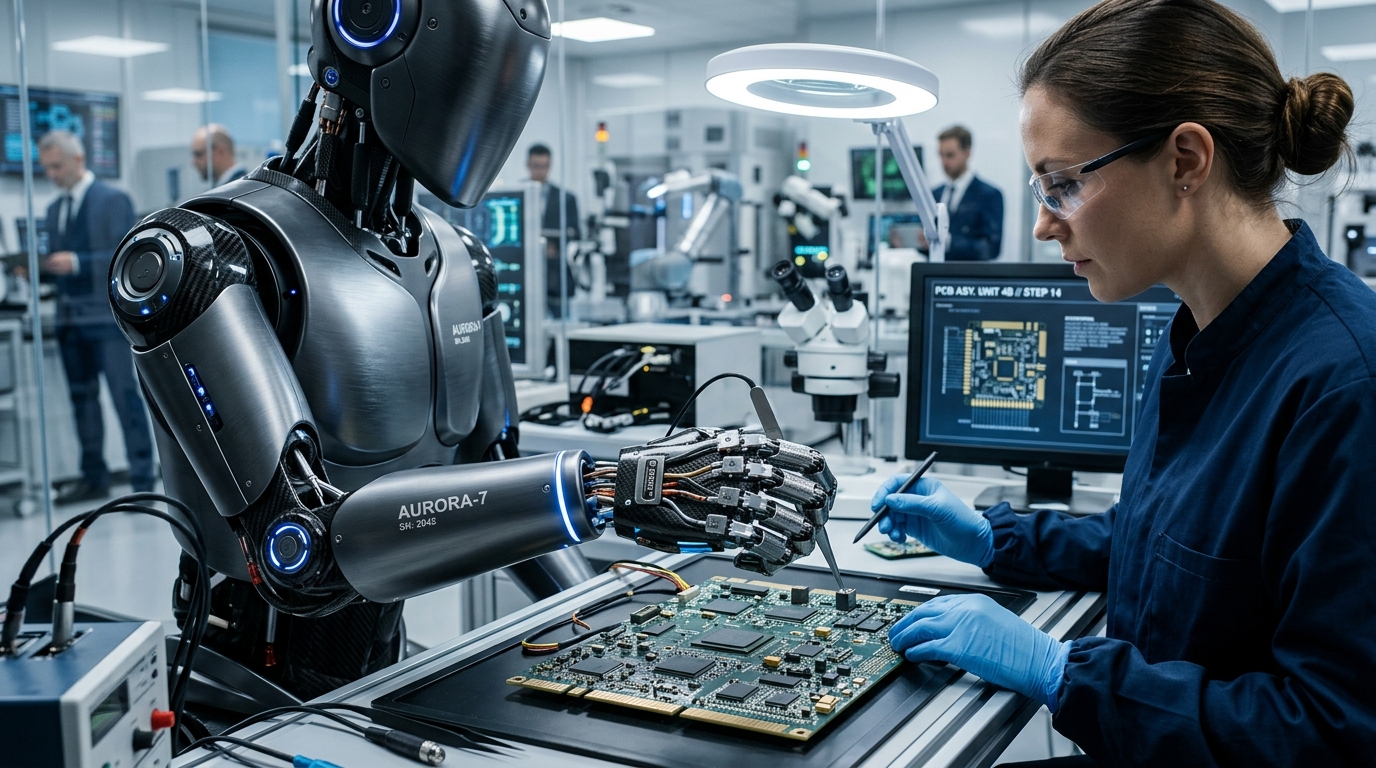
For decades, robotics operated on a simple geometric compromise: if you want a machine to assemble an engine block or move a pallet, you do not build a human. You build a rigid 6-axis articulated arm anchored to reinforced concrete, or a flat wheeled Autonomous Mobile Robot (AMR) restricted to smooth epoxy floors.
Yet in 2026, the robotics landscape has inverted. Automotive giants like Hyundai, BMW, and Tesla are deploying thousands of bipedal humanoid robots directly into brownfield manufacturing lines.
The question is no longer whether general-purpose bipedal humanoids can balance or manipulate objects. The question is the cold equation of physics and unit economics: How does the amortized cost per operating hour of an electromechanical humanoid compare to human labor, and what are the hardware and architectural breakthroughs that made 2026 the inflection point?
Let us dismantle the marketing hype and analyze the silicon, kinematic actuators, Vision-Language-Action (VLA) models, and real-world unit economics powering the physical AI revolution.
1. Why the Human Form Factor Won: The “Brownfield” Reality
The fundamental economic thesis for humanoids is not aesthetic—it is infrastructural.
Human civilization has spent over ten thousand years designing the physical world exclusively for a specific biological envelope:
- Doorway widths (800–900 mm)
- Stair riser heights (170–190 mm)
- Workbench elevations (900–1050 mm)
- Tool ergonomics, valve handles, torque wrenches, and storage bins.
┌──────────────────────────────────────────────────────────┐
│              TRADITIONAL AUTOMATION (Greenfield)          │
│ Re-architect factory → Millions in custom conveyor tooling│
└──────────────────────────────────────────────────────────┘
                            VS
┌──────────────────────────────────────────────────────────┐
│              HUMANOID EMBODIED AI (Brownfield)            │
│ Drops into existing human workstation → Zero facility mod │
└──────────────────────────────────────────────────────────┘
Re-architecting an automotive plant or logistics warehouse for specialized automation (“greenfield” engineering) requires tens of millions of dollars in fixed capital expenditure and months of downtime. A humanoid robot that can navigate standard stairs, fit through standard aisles, and grasp hand tools built for five-fingered hands can be dropped directly into an existing (“brownfield”) factory line on day one.
2. The Kinematic Hardware Stack: Actuators, Gearboxes & Hands
Building a robot that looks human is easy; building one that matches human power-to-weight density without draining a 2.5 kWh battery in 40 minutes has required radical engineering overhauls.
A. Rotary vs. Linear Actuation
Human muscles generate force through linear contraction, but traditional robotics relied almost entirely on rotary electric motors mated to high-ratio harmonic drives or cycloidal gearboxes.
In 2026, leading humanoid architectures have bifurcated into two mechanical philosophies:
- Quasi-Direct Drive (QDD) Rotary Actuators (e.g., Unitree, 1X): By utilizing low-gear-ratio planetary systems (typically under 1:10) paired with high-torque brushless outrunner motors, QDD systems achieve exceptional backdrivability and mechanical compliance. When the robot’s foot hits unexpected terrain, the mechanical shock is absorbed passively by the electromagnetic field rather than shattering rigid gear teeth.
- Integrated Linear Electro-Mechanical Actuators (e.g., Tesla Optimus Gen 2/3): Custom roller-screw linear actuators mimic biological tendon paths across major joints (knees, hips, elbows). By aligning force vectors directly along structural carbon-fiber limb segments, structural mass is minimized while peak dynamic force exceeds $5,000\text{ N}$.
Actuator Performance Metric:
Torque Density = (Peak Torque in Nm) / (Actuator Weight in kg)
• 2022 Baseline: ~35 Nm/kg (Heavy, hot, sluggish)
• 2026 Frontier: 90–120 Nm/kg (Integrated GaN inverters & liquid cooling)
B. The 20+ Degree of Freedom (DoF) Dexterous Hand
The true bottleneck of physical AI was never walking; it was the hand.
Early prototypes featured 6 to 11 DoF hands with motors located inside the palm, resulting in bulky fingers and inadequate grip strength. Frontier 2026 designs (such as Figure 02 and Optimus Gen 3) move the actuation motors and cable-drive spools into the forearm, routing high-tensile synthetic tendons through the wrist.
Equipped with tactile sensor arrays (measuring dynamic micro-vibrations and multi-axis normal/shear forces at 1 kHz), modern robotic fingers detect object slippage in less than 5 milliseconds—faster than human biological reflex latency ($~150\text{ ms}$).
3. The Software Brain: From Hand-Coded Control to End-to-End VLA Models
For decades, robotics used a modular pipeline: $$\text{Sensors} \longrightarrow \text{Perception (SLAM)} \longrightarrow \text{Trajectory Planner (MPC)} \longrightarrow \text{Motor Controllers (PID)}$$
This classical pipeline was brittle: if lighting changed or an object shifted 2 cm outside expected bounds, the planning solver failed.
Today’s physical AI runs on Vision-Language-Action (VLA) foundation models:
[ Dual Real-Time RGB-D Cameras ] ──┐
[ 6-Axis IMU & Joint Encoders ]  ──┼──► [ 7B–14B Parameter VLA Transformer ]
[ Natural Language Voice Command ] ──┘                 │
                                                       ▼
[ 50 Hz Direct Motor Torque Actions ]- Multimodal Tokenization: Video frames from the robot’s head cameras, joint angle embeddings, and natural language instructions (“Pick up the chassis bracket and insert it into slot B”) are mapped into a unified latent token space.
- Diffusion Action Heads: Instead of generating text tokens, the transformer outputs continuous probabilistic trajectories for all 28–44 joint angles simultaneously at 50 Hz.
- Sim-to-Real Reinforcement Learning: Physics simulators (like NVIDIA Isaac Sim and MuJoCo) train digital twin humanoids across billions of synthetic interaction steps—simulating variations in friction, payload weight, lighting, and actuator latency. When deployed to physical silicon, zero-shot transfer handles real-world chaos reliably.
4. The Unit Economics: Robot-as-a-Service (RaaS) vs. Human Labor
The ultimate adoption driver is financial. Let us evaluate the per-hour operational cost calculation in a typical dual-shift automotive assembly facility:
| Economic Parameter | Human Worker (US/EU Mfg) | Humanoid Robot (2026 RaaS) |
|---|---|---|
| Hourly Wage / Rate | $28.00 – $38.00 / hr | $8.50 – $14.00 / hr (All-in RaaS) |
| Benefits / Healthcare / Tax | +$12.00 – $18.00 / hr | $0.00 |
| Effective Working Hours / Day | ~7.0 hrs (Breaks, fatigue) | 20.0 hrs (Battery hot-swap) |
| Annual Fully Loaded Cost | $85,000 – $115,000 / yr | $45,000 – $65,000 / yr |
| Break-Even Payback Period | Baseline | 8 to 14 Months |
The Energy Cost Factor
A standard 70 kg humanoid robot performing continuous manipulation and walking consumes between 450W and 850W of electrical power. At industrial electricity rates of $0.12/kWh, the direct energy cost to operate a humanoid is approximately $0.06 to $0.10 per hour.
Even factoring in capital depreciation, sensor replacement cycles, and fleet maintenance overhead, the economic advantage is insurmountable for repetitive, hazardous, or high-turnover industrial tasks.
5. What Remains Unsolved: The Engineering Bottlenecks
Despite dramatic progress, three fundamental hurdles remain before humanoids enter homes as universal assistants:
- Battery Gravimetric Energy Density: Current 2.5 kWh ternary lithium / semi-solid-state packs provide 4 to 6 hours of continuous operation under payload. Increasing runtime without adding excessive payload mass requires next-generation solid-state lithium-metal cells ($>450\text{ Wh/kg}$).
- Out-of-Distribution Edge Cases: While humanoids excel at tasks they have practiced in simulation (sorting parts, machine tending), an unexpected obstacle—like a wet plastic bag caught around an ankle or an untied cable—can still trigger safe-state freezes.
- Safety Certification (ISO 10218 / 13482): Enabling heavy, high-torque metallic machines to operate in close physical contact with humans without physical safety cages requires certified force-limiting envelopes and certified fail-safe electronic braking.
Frequently Asked Questions
Will humanoid robots replace traditional industrial robotic arms?
No. For high-speed, sub-millimeter precision tasks (such as laser welding or high-throughput pick-and-place at 120 parts per minute), dedicated articulated arms and SCARA robots remain far superior in speed, rigidity, and cost. Humanoids replace flexible manual labor in unstructured environments where fixed machines cannot be installed.
How do humanoid robots recharge during 24/7 manufacturing shifts?
Most industrial fleets use autonomous docking pads or automated hot-swappable battery bays. When charge drops below 15%, the robot walks to an exchange station, an automated robotic arm swaps its rear battery pack in 90 seconds, and the robot immediately returns to its workstation.
What chips power physical AI on humanoid robots?
Frontier humanoids typically run on dual-tier computing: a low-power real-time microcontroller (ARM Cortex-R / STM32) handling 1 kHz joint PID stability loops, paired with an automotive-grade AI SoC (such as NVIDIA DRIVE Thor, Tesla FSD Computer, or Qualcomm Robotics RB5/RB6) executing the 7B–14B parameter VLA neural networks locally.
Dispatches and technical evaluations by Saurav Karki for Kritrimta.