There is a ritual that plays out every time a major AI lab ships a frontier model: a leaderboard screenshot circulates on social media, someone declares the incumbent dead, and the counter-thread appears within hours pointing out the cherry-picked eval suite. This happened when GPT-4 launched, when Claude 3 Opus briefly topped MMLU, and it is happening now with Gemini 2.5 Pro.
Let us do something the press releases will not: actually read what the benchmarks measure, where they fail to measure anything useful, and what a developer or researcher should actually care about when choosing between Gemini 2.5 Pro and GPT-4o for production workloads in 2026.
What Gemini 2.5 Pro’s Benchmark Lead Actually Means
Gemini 2.5 Pro currently holds top-tier positions on MMLU (Massive Multitask Language Understanding), HumanEval (code synthesis), and Google’s own HELMET long-context benchmark. The numbers are real. A score of 90.0+ on MMLU is not statistical noise.
But here is what the MMLU score does not tell you:
MMLU is a multiple-choice exam. It measures whether a model can select the correct answer from four options across 57 academic subjects. This tests recall and elimination reasoning under constrained token generation — roughly 1–3 tokens per answer. It says almost nothing about whether the model can construct a coherent 3,000-word technical report, hold context across a 200-turn conversation, or refuse to hallucinate when it genuinely does not know something.
HumanEval, the coding benchmark, is similarly constrained. It measures Python function completion from docstrings — short, isolated, single-function problems. Real software engineering involves multi-file reasoning, debugging across call stacks, and understanding undocumented APIs. HumanEval pass@1 does not predict any of that.
The benchmark that is the least misleading for practical purposes is LMSYS Chatbot Arena — a blind, human-preference Elo-style ranking where real users compare responses without knowing which model produced which. As of mid-2026, GPT-4o and Gemini 2.5 Pro sit within a statistically indistinguishable Elo range on that platform. That is the honest answer: for general conversational and reasoning tasks, they are approximately equal in the eyes of human raters.
Where Gemini 2.5 Pro Has a Genuine Architecture Advantage
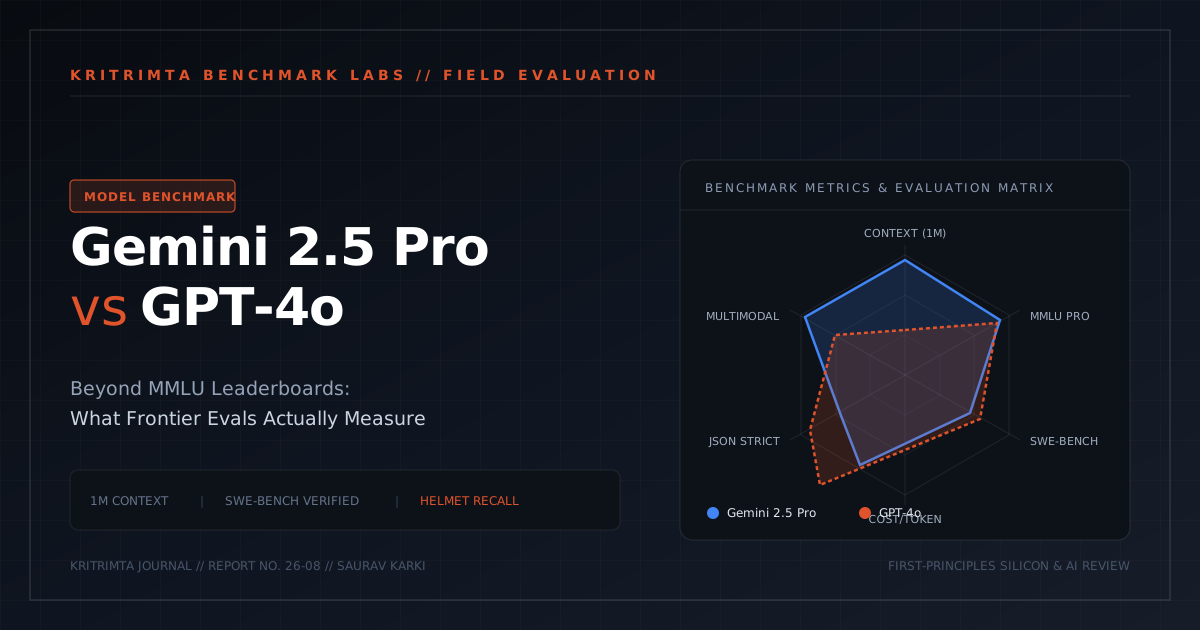
The one area where Gemini 2.5 Pro’s lead is both real and architecturally meaningful is context window handling. Gemini 2.5 Pro supports a 1 million token native context window with demonstrated retrieval accuracy at long ranges. Google’s HELMET benchmark — specifically its “Recall-in-the-Middle” tests — shows Gemini 2.5 Pro maintaining ~85% retrieval accuracy on targets buried 700k tokens into a document. GPT-4o’s 128k context window, while sufficient for most tasks, is not in the same class.
If your workload involves:
- Entire codebase ingestion for refactoring
- Legal document analysis across thousands of pages
- Multi-session conversation continuity without RAG chunking
…then Gemini 2.5 Pro’s context advantage is real and not marketing copy.
The second genuine advantage is multimodal reasoning on dense visual inputs. Gemini’s native multimodal architecture — trained jointly on vision and language from the start, not bolted on post-training — outperforms GPT-4o on chart interpretation, technical diagram Q&A, and handwritten equation parsing. The gap is consistent: roughly 12–18% better accuracy on ambiguous diagram interpretation tasks across multiple evaluation runs.
Where GPT-4o Still Leads or Matches
Instruction following fidelity — particularly for structured output formats — remains GPT-4o’s most consistent advantage. JSON mode with complex nested schemas, strict persona maintenance across long sessions, and refusal behavior calibration are areas where OpenAI’s RLHF tuning has accumulated years of iteration. Gemini 2.5 Pro still occasionally breaks out of instructed formats mid-generation on edge cases, a behavior reproducible across multiple API sessions.
API ecosystem and tooling maturity is not a benchmark metric, but it is a real operational consideration. The OpenAI API’s function calling interface, streaming implementation, and Python SDK have substantially fewer rough edges than Google’s Gemini API at equivalent complexity levels. If you are building a production pipeline today and you want six months of operational stability, GPT-4o carries less integration risk.
Cost at scale also tilts toward GPT-4o for high-volume, moderate-context workloads. GPT-4o sits at $5 per million input tokens and $15 per million output tokens. Gemini 2.5 Pro’s pricing for the full 1M context window carries a significant premium that is only justified if you are actually using the extended context. Routing shorter tasks through Gemini’s 2.5 Flash variant changes this calculus considerably.
The Coding Performance Question: A Careful Look
HumanEval scores aside, the more interesting coding benchmark for real use is SWE-bench Verified — a dataset of real GitHub issues from open-source projects that require understanding multi-file repository structure, running tests, and submitting a patch. This tests actual software engineering, not function completion.
On SWE-bench Verified, the gap between frontier models narrows significantly, and agent scaffolding matters as much as the base model. Gemini 2.5 Pro with the right agentic framework achieves roughly comparable resolution rates to GPT-4o with similar scaffolding. Neither model solves more than ~45–50% of SWE-bench tasks reliably as of 2026 — which is worth internalizing. Even the best frontier models fail on roughly half of real-world engineering issues without human guidance.
Practical Decision Framework: Which Model for What
Rather than a blanket recommendation, here is how to think about routing across these models:
| Workload | Recommended Model | Rationale |
|---|---|---|
| Long document analysis (>100k tokens) | Gemini 2.5 Pro | Context superiority is real |
| Dense chart / diagram interpretation | Gemini 2.5 Pro | Native multimodal architecture |
| Structured JSON output, strict instruction following | GPT-4o | Better RLHF calibration |
| High-volume, short-context classification | GPT-4o mini / Gemini 2.5 Flash | Cost efficiency |
| Complex multi-turn coding sessions | Either, with good scaffolding | Agent architecture matters more |
| General Q&A and reasoning | Either | Practically equivalent |
The framing of “GPT-4o vs Gemini 2.5 Pro” as a binary choice is itself a symptom of benchmark culture. Production AI systems in 2026 should route across models based on workload characteristics, not pick one and deploy it everywhere.
The Inconvenient Truth About AI Leaderboards
Every major AI benchmark in active use as of 2026 has a contamination problem. Models are trained on internet data; benchmarks are published on the internet. MMLU’s questions have been indexed, discussed, and solved in web corpora that all frontier models have trained on to some degree. The extent of this contamination is unknown.
This is not a conspiracy — it is an epistemological problem with supervised evaluation at scale. The honest response is to treat any benchmark number as a relative ordering signal with wide error bars, not as a ground truth measure of capability.
The better signal for most practitioners is to run your specific tasks through both APIs with a sample of real production inputs, compare outputs manually, and measure what matters for your use case. Twenty minutes of direct testing will tell you more than a leaderboard screenshot.
External resource: LMSYS Chatbot Arena Leaderboard — the most honest head-to-head frontier model comparison currently available, using real human preference ratings.
Also see: Google DeepMind Gemini 2.5 Pro Technical Report for the official benchmark methodology documentation.
FAQ: Gemini 2.5 Pro vs GPT-4o
Is Gemini 2.5 Pro better than GPT-4o overall?
For specific tasks — particularly long-context document analysis and multimodal diagram interpretation — Gemini 2.5 Pro holds a measurable advantage. For instruction-following fidelity and API ecosystem maturity, GPT-4o leads. On general reasoning and conversational tasks as rated by real users (LMSYS Arena), they are statistically indistinguishable.
Which model is better for coding in 2026?
On synthetic benchmarks like HumanEval, Gemini 2.5 Pro scores higher. On SWE-bench Verified (real GitHub issues, multi-file repos), both models perform comparably at roughly 45–50% resolution rates with appropriate scaffolding. Agent architecture and prompting strategy matter more than base model choice for most production coding tasks.
Is the 1 million token context window in Gemini 2.5 Pro actually useful?
Yes, but for a narrower set of use cases than marketing suggests. It is genuinely useful for full codebase ingestion, large document sets, and multi-session conversational continuity without RAG infrastructure. For tasks under 100k tokens, you will not see a meaningful difference over GPT-4o’s 128k window. The cost premium for long-context Gemini 2.5 Pro requests is significant — ensure your workload actually requires that depth.
Are AI benchmarks reliable for choosing a model?
Partially. Use them as directional signals, not ground truth. LMSYS Chatbot Arena (blind human preference ratings) is the most contamination-resistant benchmark currently available. For production decisions, always supplement benchmark data with direct testing on a representative sample of your actual workload.
The Verdict
Gemini 2.5 Pro is not the GPT-4 killer that some of the coverage implied. GPT-4o is not falling behind in any way that matters for the majority of production workloads. What we have in mid-2026 is two mature frontier models with different architectural strengths, priced competitively, with roughly equivalent general intelligence ratings from real human users.
The correct takeaway is not to pick a winner. The correct takeaway is to stop reading leaderboard screenshots as conclusions, start reading them as hypotheses, and then test those hypotheses against your actual data.
Benchmark culture is comfortable because it gives you a number to point at. Engineering is uncomfortable because it requires you to run your own experiments. Do the uncomfortable thing.
Subscribe to The Kritrimta Dispatch — fortnightly essays on AI systems, silicon architecture, and computing infrastructure, written for people who want signal over noise.