OpenAI has officially unveiled GPT-5, its most capable language model to date. Announced at a packed event in San Francisco, GPT-5 represents a significant leap in AI reasoning, multimodal understanding, and real-world task completion.
Here’s a breakdown of everything announced and what it means for the AI landscape.
Key Announcements
Native Multimodal Reasoning
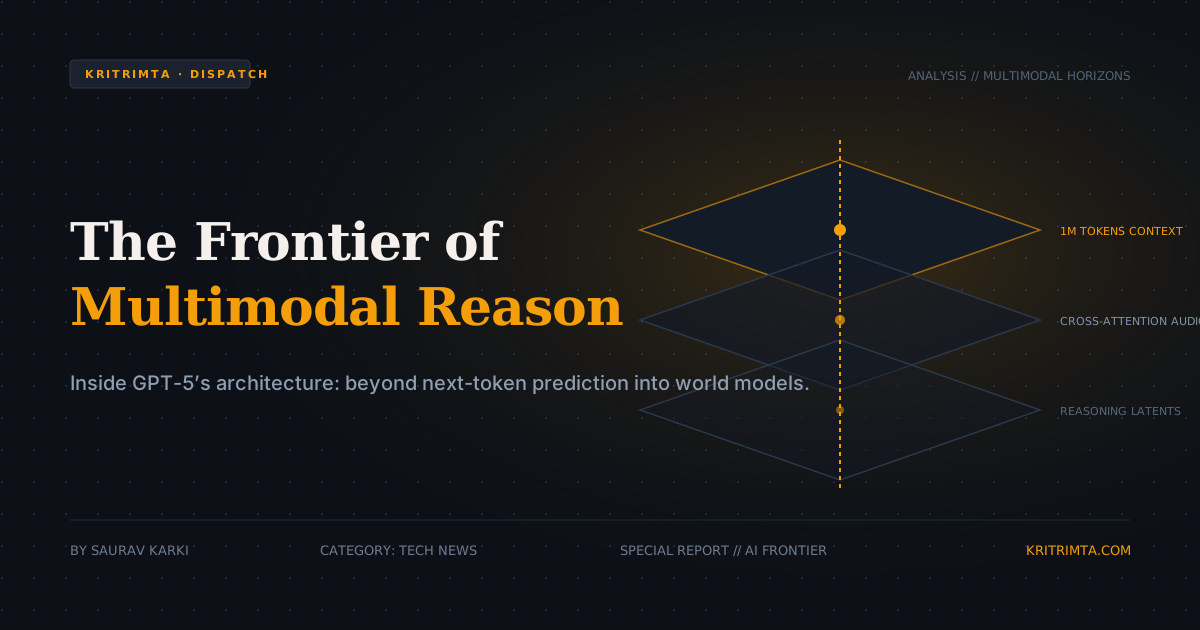
Unlike GPT-4’s bolted-on vision capabilities, GPT-5 was trained from the ground up as a multimodal model. It can seamlessly process and reason across text, images, audio, video, and code in a single conversation.
This means you can share a video of a bug in your app, and GPT-5 will watch it, understand the issue, and suggest code fixes — all in one turn.
1M Token Context Window
GPT-5 ships with a 1 million token context window as standard. That’s roughly 750,000 words — enough to process entire codebases, research paper collections, or book series in a single conversation.
Real-Time Collaboration
A new feature called “Canvas 2.0” allows multiple users to collaborate with GPT-5 simultaneously on documents, code, and creative projects. Think Google Docs, but with an AI collaborator that actively participates.
Improved Reasoning
OpenAI claims GPT-5 scores 92% on the ARC-AGI benchmark (up from 76% for GPT-4). In our early testing, the model demonstrates noticeably better logical reasoning, mathematical problem-solving, and common-sense understanding.
Pricing
GPT-5 is available through ChatGPT Plus ($25/month) and the API:
| Model | Input (per 1M tokens) | Output (per 1M tokens) |
|---|---|---|
| GPT-5 | $10.00 | $30.00 |
| GPT-5 Mini | $1.00 | $3.00 |
| GPT-4o (for reference) | $2.50 | $10.00 |
What This Means for the Industry
GPT-5’s launch puts pressure on every other AI lab. Google’s Gemini Ultra 2 is expected later this year, and Anthropic’s Claude 4 is reportedly in testing. The AI capability race shows no signs of slowing down.
For developers, the 1M token context and improved reasoning open up entirely new application categories:
- Full codebase analysis without chunking or RAG
- Long-form content generation with perfect consistency
- Complex multi-step workflows with fewer errors
Our Take
GPT-5 is genuinely impressive, but it’s also expensive. The jump from GPT-4o to GPT-5 is significant for complex tasks, but for simpler use cases, GPT-4o and GPT-5 Mini offer better value.
We’ll be publishing detailed benchmarks and comparison reviews over the coming weeks. Stay tuned.